


This is a guest post by Stanislav Galandzovskyi. Stanislav is an Acquisition & Growth Consultant who has helped 20+ fintech companies build their marketing systems and enter new markets. He has worked with major fintech players, including NAGA Group and Zilch, managing $3M+ in monthly ad budgets and running campaigns in 120+ countries.
Back in 2024, I ran a competitive analysis of the prop trading space and catalogued 376 firms. I checked that list again recently. The domains of 84 of those firms are no longer active. A good portion still have websites up, but show no signs of active operations with no recent payouts, social activity, and ad spend. That is a lot of firms gone in under two years.
But the demand side of this market has not weakened. Survey data from PipFarm covering 2,777 traders found that 94% of prop traders enjoy trading and 96% plan to continue long-term. Trader numbers are growing. Interest in funded accounts is real and persistent. So the issue is not that people have stopped wanting what prop firms offer. The issue is on the supply side, in how firms are approaching the business of building and marketing themselves.
I want to work through what I see happening – why so many firms struggle to acquire traders sustainably – and share a framework that I believe gives firms a proper marketing system to build on. The kind of foundation that any serious company in any category would need to use.
The Mindset That Creates the Problem
Many people enter the prop firm space because the business model appears to offer a fast return: challenge fees come in quickly, the product is digital, and the overhead looks manageable. So, founding teams arrive with a sense of urgency.
This urgency tends to produce a predictable set of decisions. The first is copying competitors. If FTMO or The Funded Trader has a certain structure, a certain visual identity, a certain type of offer, it feels rational to replicate what appears to be working. The second is borrowing the eCommerce playbook – running discount-heavy campaigns, spinning wheels, countdown timers, and promotional codes – assuming they will drive more conversions. The third is treating marketing as a series of individual tactics rather than a connected system, which means channels are activated without a clear picture of how they work together.
None of these decisions is irrational given the founding team’s goals. The problem is that they are structurally mismatched with how prop trading actually works as a category, and specifically with how traders make their decisions. The result is firms that acquire some traders early but then find that those traders do not stay, repeat purchases, or refer others. That’s why CAC stays high, revenue stays unpredictable, and at some point, the business closes.
To understand how to solve this, we first need to look at how traders make their decisions about prop firms.
How Traders Actually Make Decisions
If we look at the data and recent news, we can see that prop traders are a pretty careful, experienced, and increasingly skeptical audience. Most prop traders – around 70% according to PipFarm survey data – entered the markets through FX or crypto before they ever encountered a prop firm. They arrive with trading experience, with community connections, and with a sharp eye to tell a credible firm from a questionable one.
Discovery happens through trusted people
Research conducted by FXStreet across traders from ten countries found that most traders discover prop firms through IBs, affiliates, or other traders they already trust – people from educational programmes they attended, community leaders they follow, or social media traders whose track record they respect.
This has a direct implication for marketing strategy. A firm running paid ads will reach traders who will then go and look for community signals, peer recommendations, and familiar names before they convert. If those signals are not there, the ad spend does its job, but the conversion does not happen.
The independent research phase
Once a trader has heard about a firm, they go to YouTube. They search for reviews from other traders who have used that firm, look for what challenges they encountered, and try to understand what the experience of trading with that firm actually feels like. This is true in Asia, Latin America, Europe, and Africa.
From there, traders move to Reddit, X, and Trustpilot. They read comments, notice when reviews look fake, and treat obvious manipulation as a red flag. The volume of reviews matters, but so does whether the feedback feels like it came from real people.
Being present in the channels above is extremely important for your paid acquisition effectiveness. A trader who clicks a paid ad and then finds no credible reviews in the research phase is a trader the firm paid to lose.
What traders are actually evaluating
When traders assess a firm, the hierarchy of what they care about is clear, thanks to PipFarm Trader Survey and similar studies. It is also not something most marketing in this space reflects. Here is what the data shows:
| Evaluation criteria | % of traders citing it |
| Clear rules | 78.6% |
| Fast payouts | 74.5% |
| Lowest price | 39.2% |
| Significant payout proof | 37.0% |
| High-profit share | 17.0% |
| Easy challenge | 15.7% |
| At least 1-year track record | 15.0% |
| Lots of online reviews | 12.2% |
| Giveaways | 10.7% |
The FXStreet research adds an important nuance here: traders who were interviewed identified consistently low pricing as a warning sign. When a firm always has a heavy discount running, experienced traders read it as instability. This is an important signal for firms that have built their acquisition model around permanent promotions.
What traders want to avoid tells the same story. Trailing drawdown was the most avoided feature at 53.8%, followed by consistency rules at 52.7%, and news trading restrictions at 37%. What does it mean for your marketing? And this has a direct implication for your messaging: if traders are making decisions based on rule design and operational clarity (and not price alone), that is exactly what your marketing should speak to.
Traders are running a portfolio, not making a one-time purchase
One of the more important shifts in this market is that 63% of traders work with more than one prop firm simultaneously. Among those trading with multiple firms, 51% use two at the same time and 30% use three. The primary motivations are risk diversification across firms and increasing total capital available.
This behaviour reflects a community that has become conscious of counterparty risk. After a period of firm closures and unexpected rule changes, traders learned to spread their exposure. Some advanced traders are also aware that becoming too profitable at one firm is a risk.
What this means for your marketing is that traders are not making impulsive decisions – that’s why an eCommerce-style approach with heavy discounts does not work in fintech. Traders are evaluating which firms are worth including in their system. And what earns a place in that system is brand trust, operational transparency, and long-term stability.
The 360 Marketing Framework
Here is how I think about what a complete marketing system looks like for a prop firm operating in this environment. The framework has three layers, and each one makes the next more effective. The reason most firms underperform is that they try to run the third layer without building the first two.
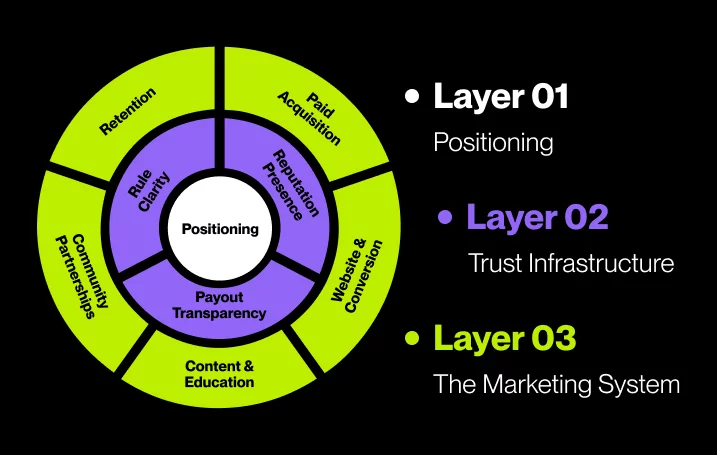
Layer 1: Positioning
Positioning is the starting point because everything else in marketing either supports or contradicts it. The core question is simple: if a trader remembers one thing about your firm, what should it be? Most firms cannot answer this. That’s why we have copy-pasted websites, similar promises in ads, and identical offers.
Meaningful positioning comes from something rooted in how the product actually works – rule design, payout speed, account structure, the type of trader the firm is genuinely built for, or the markets it covers well. It needs to be specific enough to be believed (not ‘fast payouts’ but ‘average payout in 12 hours’), simple enough to be understood in the first ten seconds on a landing page, and genuinely different from what three other firms are also claiming.
A useful test: take your homepage hero section and replace your firm name with a competitor’s. If it still reads accurately, the positioning is not working. Differentiation lives in specifics, and traders actively compare firms side by side. The firms that give them something concrete to hold onto are the ones traders remember when it is time to decide.
Layer 2: Trust Infrastructure
It has three components. The first is the reputation presence on the platforms where traders do their independent research. YouTube reviews from real traders, a Trustpilot profile that is regularly updated wth real comments, and an active presence in Reddit threads and trading communities. This is not advertising. It is the background layer that either confirms or undermines the paid work happening elsewhere.
The second component is payout transparency. Survey data is consistent across sources: traders want current, specific, and verifiable payout proof. Not claims from two years ago and not vague aggregate numbers. Actual recent payout volumes, average processing times, and real trader stories connected to real figures. When a firm can show what was paid out last month and how long it took, skepticism drops significantly.
The third component is rule clarity. Traders actually view firm rules as a positive, because they push them toward more disciplined behaviour. And 78.6% of traders cite clear rules as their top priority when choosing a firm. So, firms that document their rules clearly, explain the reasoning behind them, and make them easy to find will have an easier time converting traders.
Layer 3: The Marketing System
With positioning established and trust infrastructure in place, the acquisition and retention system can function as intended. This layer covers five interconnected areas.
Paid acquisition covers several channels, each serving a different role. Google Search captures high-intent traders who are actively comparing firms and have already decided they want a funded account – it is the most efficient channel for direct conversion. Meta and TikTok serve awareness and prospecting functions earlier in the decision journey, building familiarity before traders begin active comparison.
The website and conversion layer are where all other marketing either pays off or fails. A landing page that does not deliver the firm’s positioning in the first ten seconds, that uses stock photo testimonials, that buries challenge rules in submenus, or that makes traders hunt for basic information about pricing and payouts is undoing the work of every other channel. The priorities are: fast load time on mobile, a hero section that makes the firm’s specific value immediately clear, trust signals that feel real and current, and a purchase flow that does not create unnecessary friction.
Content and education are the layer that builds a relationship with traders before they become customers. Over 43% of prop traders listen to podcasts about mindset and psychology, 41.5% keep trading journals, and nearly 40% read trading psychology books. This is an audience that is actively investing in their own development. And the most common challenges they face are a lack of discipline, emotional trading after losses, and financial pressure. Content that addresses these struggles, whether through articles, videos, educational resources, or community-based learning, attracts traders through organic search and community sharing, and it builds a relationship that makes conversion more likely and retention more durable.
Community and partnerships are how discovery actually happens in this market. This makes affiliate and influencer relationships a primary discovery channel, and the distinction that matters is between partners who generate short-term hype and those who have built genuine, education-oriented relationships with their audience. The traders who arrive through the latter tend to be better qualified, more engaged, and more likely to stay.
When it comes to retention, we need to look at data on what makes traders switch firms: they leave for better promotional deals or more attractive challenge rules elsewhere. This means traders acquired transactionally tend to leave the same way. Traders who stay cite a general sense of comfort and familiarity with the firm – something that is built through consistent experience, reliable communication, and a feeling that the firm is invested in their progress. Email sequences, community touchpoints, and re-engagement campaigns for inactive traders all play a role here, but the foundation is an experience worth staying for.
Executive Summary
The prop trading market is not going away. Trader demand is real and growing. But the period in which a firm could launch with a copied template, run discount campaigns, and expect sustainable revenue is over. The firms that closed in the last two years were not necessarily bad businesses in concept – many had real products. The gap was in how they approached the work of reaching and building relationships with traders. And that is a gap the 360 Marketing Framework is designed to close.
| Area | Key insight | What to do about it |
| Why firms close | Most firms that close are not victims of weak demand. They are victims of a marketing approach that is mismatched with how traders actually make decisions. | Treat marketing as a system, not a collection of tactics. |
| How traders make decisions | Traders discover firms through trusted people, research them independently on YouTube, Reddit, and Trustpilot, and evaluate them primarily on rule clarity and payout reliability – not price. | Build presence in the channels where traders form their views. |
| Positioning | Most prop firms look and sound identical. Traders compare firms side by side, and the ones without a specific, concrete value proposition are the ones that get filtered out. | Identify one thing your firm stands for that is specific, believable, and different from what competitors claim. |
| Trust infrastructure | Reputation presence, payout transparency, and rule clarity are active parts of the conversion funnel. Traders who find weak signals in the research phase will not convert, regardless of how good the ad was. | Actively manage your presence on YouTube, Trustpilot, and Reddit. |
| The marketing system | Paid acquisition, website, content, community, and retention work as a connected system. Each layer makes the next one more effective. Running paid ads without the other layers in place produces inconsistent and expensive results. | Work on three layers to build a sustainable business: positioning, trust infrastructure, and marketing system. |