


This article is a guest post by Ryan Beasley, Founder of prop trading technology provider Propriotec.
The most expensive mistake in prop isn’t a bad evaluation plan. It’s a good one running on the wrong infrastructure.
Two firms can run identical evaluation plans. Same challenge structure, same drawdown percentages, same consistency limits, same daily loss caps. And end up with completely different pass rates and payout ratios.
Not because of the rules.
Because of what’s underneath them.
The evaluation plan is the policy.
The infrastructure is the enforcement.
And most firms obsess over the policy while barely questioning the enforcement layer.
The Hidden Risk: Running Prop on Infrastructure That Was Never Built for It
The most dangerous failures in trading infrastructure aren’t dramatic crashes.
They’re the silent ones.
The ones that keep running while getting it wrong.
Most prop firms start on broker CRMs. It makes sense on paper. They already handle onboarding, KYC, deposits, withdrawals. They’re familiar. They’re established.
But broker CRMs were built for live brokerage models, not evaluation-based business models.
That mismatch is where problems begin.
1. Status Is Just a Group Change
In many broker CRMs, “passed” and “failed” aren’t real states. They’re group movements.
Move a trader from Group A to Group B and the system calls it progression.
There’s no structured evaluation logic, no audit clarity, no stage tracking designed around challenge lifecycles, and no native understanding of drawdown monitoring.
It’s not enforcement logic. It’s account management pretending to be risk control.
2. The Data Simply Isn’t There
Prop firms live and die by their statistics: challenge pass rates, funded conversion rates, payout ratios, breach distributions, and risk exposure over time.
These aren’t “nice to have” dashboards. They determine whether your model is sustainable.
Broker CRMs don’t track these because brokers don’t need them.
So firms either export to spreadsheets, build reporting layers on top, or fly blind.
If you can’t instantly answer:
What’s our current challenge pass rate?
What’s our payout rate this month?
Then your infrastructure isn’t built for your business model.
3. Silent Enforcement Failures
Daily drawdown trackers reset CRM-side.
That’s the source of truth.
If the reset fails at rollover, traders wake up falsely breached.
One false breach is a support ticket.
A hundred false breaches is chaos.
A firm with 8,000 active traders does not have a support team built for 8,000 simultaneous complaints. One bad rollover cycle, one missed reset, and you’re not running a prop firm anymore. You’re running a crisis centre.
This is what makes broker infrastructure dangerous in prop.
It wasn’t built to enforce evaluation logic at scale. It was built to track balances.
4. Operational Drag You Don’t Notice Until It’s Too Late
Running a prop firm means constant admin: account resets, evaluation disputes, manual breach reviews, payout approvals, stage transitions, and contract automation.
Broker CRMs weren’t designed for these workflows.
So everything becomes manual.
Manual means slower decisions, inconsistent enforcement, staff dependency, and higher operating costs.
Some firms respond by building their own system.
That feels like control.
In reality, you’ve just signed up to run two businesses: a prop firm and a software company.
Now someone has to maintain it. Fix it at 2am. Handle edge cases. Manage integrations.
And none of that grows revenue.
This is the pattern we see constantly at Propriotec. Firms stuck between infrastructure that wasn’t built for them and the pain of migrating away from it.
The Trading Environment: Where Most Firms Quietly Bleed Risk
Even firms that fix their CRM layer often ignore the trading environment itself.
They sign with a platform provider. They accept default settings. They go live.
Leverage configuration matters, especially across volatile instruments like crypto and indices.
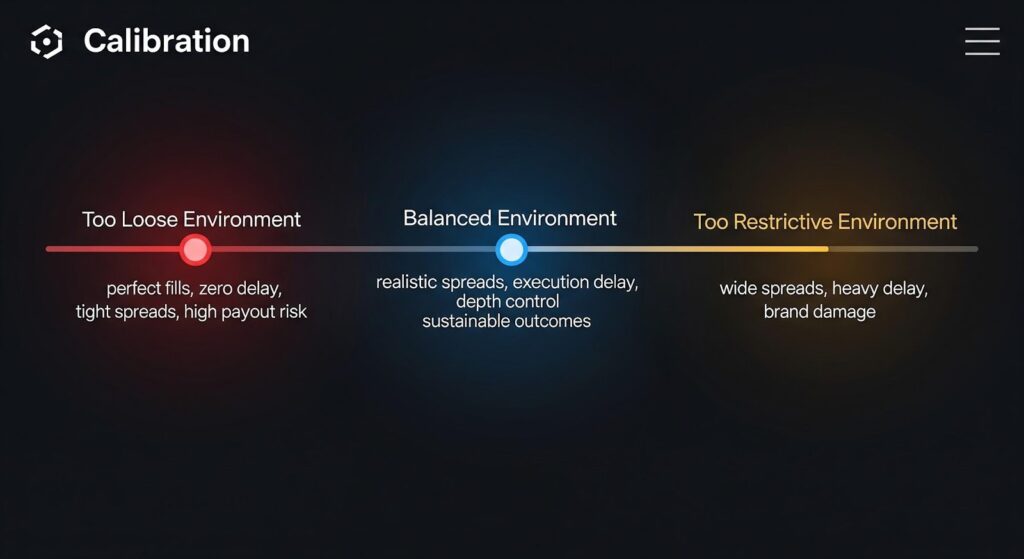
But the bigger levers are spread configuration, execution delay, and order book depth.
Instant execution with perfect depth is not realistic. It’s a gift to traders.
If your simulated environment fills every order at the exact price with zero delay and no depth constraints, you’ve built a fantasy market.
Traders pass challenges under conditions they will never see in live execution.
Then when you A-book funded traders into real liquidity, reality hits.
The goal isn’t to make it harder to pass.
The goal is to make it honest.
That means spreads that widen, execution delay that reflects real latency, and depth management that simulates slippage and partial fills.
Too loose, and you bleed risk. Too tight, and you damage brand trust.
The firms that survive long-term understand that calibration is infrastructure, not preference.
The Two Numbers That Tell You Everything
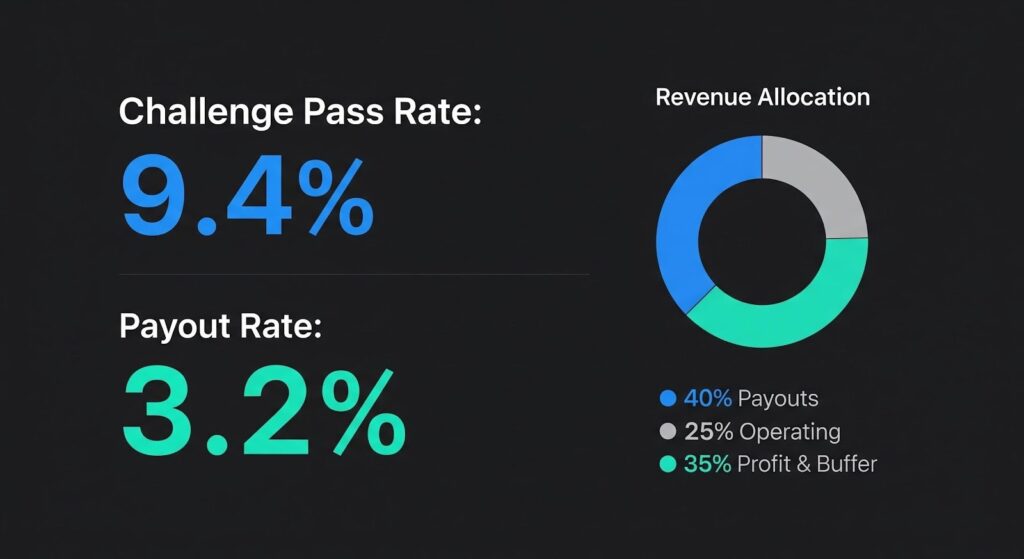
A properly built prop infrastructure can answer two questions instantly: what is our challenge pass rate, and what is our payout rate?
These are not vanity metrics.
They are the heartbeat of the model.
Healthy firms typically operate around 8–12% challenge pass rates, payout rates below 4%, roughly 40% of revenue to payouts, and 20–30% operating costs.
If you need spreadsheets and manual reports to find those numbers, your infrastructure isn’t built for prop.
It’s adapted for it.
And adapted systems always break under scale.
Infrastructure Isn’t a Support Tool. It’s the Business Model.
Risk management in prop doesn’t start when a trader opens MT5.
It starts with enforcement logic, environment calibration, data visibility, and automation reliability.
In prop, infrastructure doesn’t support the business model.
It is the business model.