



A general problem for anyone starting a broker today is that you are dealing with a highly saturated market and are competing against companies that can outspend you, to the tune of tens or even hundreds of millions, in marketing, technology, and operations.
Even though it’s not that old as an industry, it seems like prop trading has already gone through a process like this. If you start out today, you are competing with 5 – 10 massive players, who can kill you on ad spend and brand reputation.
To top that off, there is no whale client that can help you out. A new broker could get lucky with an IB and get big deposits. Props can’t do this as they have to just take challenge fees.
Maybe I am naive and not in tune with what’s really going on but the anecdotes you hear more and more make it seem like there is some kind of compression happening in the market at the moment.
Over the last couple of weeks we’ve seen FunderPro stop B2B services, one broker-backed firm shut down, and then Instant Funding acquire Funded Trading Plus. Companies don’t tend to behave like this when things are going swimmingly.
“I am seeing deal flow every single day at the moment,” the CEO of one prop firm told me last week. “And it’s just client books because these guys are getting slaughtered. They cannot make money from the business.”
Why would this be happening? I think there are a few factors driving it.
First is the dynamic I described at the start. You now have a lot of big players, who are sucking up most traffic and clients. It is hard to survive when this is happening.
Another factor, which we have looked at before, is that firms probably get hit hard when there is increased market volatility. There is no doubt, for example, that a lot of firms got wrecked by precious metals trading at the end of last year and the start of this one.
The problem that firms then face is that, under these circumstances, they have to loosen rules and make their offer more attractive. In doing so, they open themselves up to abusers and scammers, who can end up rinsing them.
A final point, brought to our attention by a tech vendor in the space, is that a lot of new entrants are – and you may find this shocking – too nice to traders. In practice, that means they look to respect all withdrawals and don’t cancel accounts.
As I joked many eons ago, the reason some props have likely succeeded is because they have a very important rule: if you make money, your strategy has breached the rules and so you lose your account.
Some props may not be doing exactly this, but they are much harsher than others on cancelling accounts.
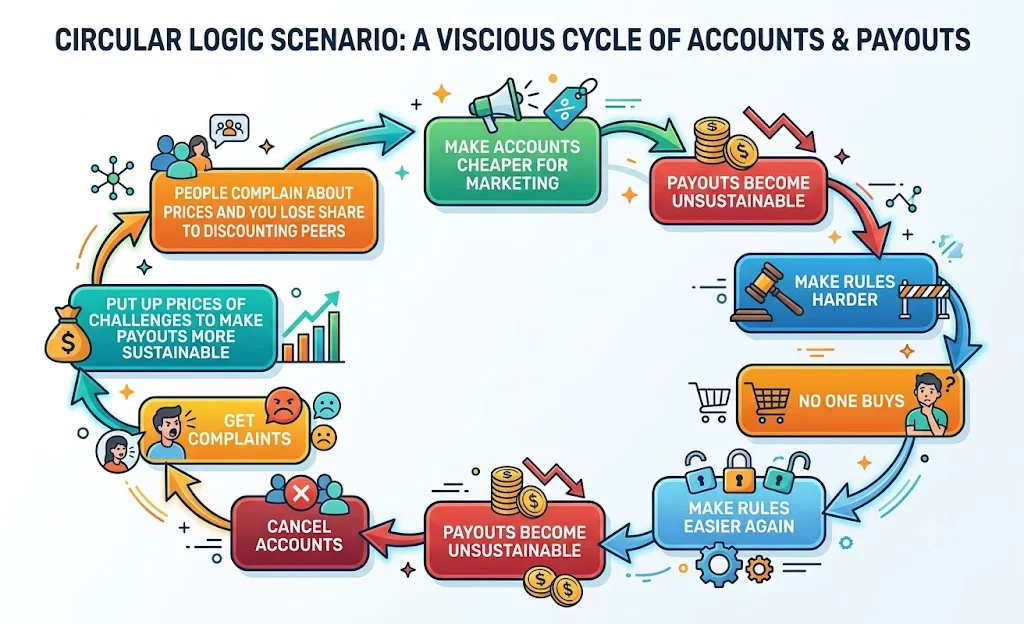
Of course, this itself causes other problems. If you use nebulous rules to cancel accounts, you get client complaints. If you make your rules too hard then no one will buy your challenges. If you loosen rules but make challenges more expensive, no one will buy your challenges.
This is why I would guess that some props have become exceptionally good at (1) balancing rules with price and (2) doing online reputation management. If you are not good at these things you will die.
I think it’s because of this that a lot of people seem to believe the industry will reach a kind of equilibrium, where everyone accepts that bottom of the barrel pricing and loose rules won’t work, so no one does it.
The trouble with this is that there is always a strong marketing incentive to do the opposite. So then you get back to square one.
And to that point, earlier this year I talked to a prop founder who was saying ‘there’s going to be a change / new reality / new standards etc etc’. His goal was to start capping payouts. What are they doing now?
Instant funding, 90% profit splits, and big discounts.
C’est la vie. Have a good weekend everyone.