



Reach over 8m active traders with cTrader today
An oddly vivid and banal memory of the last 12 months that I have is going to a hipster restaurant next to Borough Market with a bunch of neeks, eating humus and drinking red wine.
One of these neeks was (and is) the manager of a fund that invests in technology companies. We got talking about how gambling firms are one of the only ‘tech’ success stories in the YooKay today and the fact they are big cash cows for the owners.
He wouldn’t invest in them though for a few reasons.
Primarily, it’s because they don’t scale, so even if your returns are amazing, impact on overall fund performance is poor and you then can’t find a buyer to get rid of your holdings.

Get the real deal prime-of-prime with ATFX Connect
The other point he made was along the lines of, “when you dig into these companies, you usually find that 80% of their revenue is made by about 5 people. It’s a bit grim really.”
“hmmm,” I said. “Yes, that is terrible. I can’t imagine working in an industry like that.”
I was reminded of the final part of the conversation this week because of data released by Capital.com.
That showed average deposits in the UK were north of $18,000. However, the median deposit was $1,526. The average was thus skewed much higher by a small number of heavy hitters.

Get a Match-Trader Server today
The same set of data revealed that 0.31% of Capital’s MENA clients had deposited over $1m.
When you work through the percentage into real numbers, it means the broker has ~200 clients in the UAE with deposits of that size, compared to total active traders in the MENA region of 62,800.
Interestingly this aligns closely with what you’d expect.

Start using Centroid to manage your broker’s risk
Let’s assume that 80% of revenues are generated by 20% of clients but that you can also keep doing that ratio repeatedly. In other words if you took the 20% of clients that generated 80% of revenues, within that amount, 20% of clients would also generate 80% of revenues.
To use IG as an example, last year their UK trading business had ~104,200 customers who generated £293.5m in revenue.
You can see this broken down in the table below…
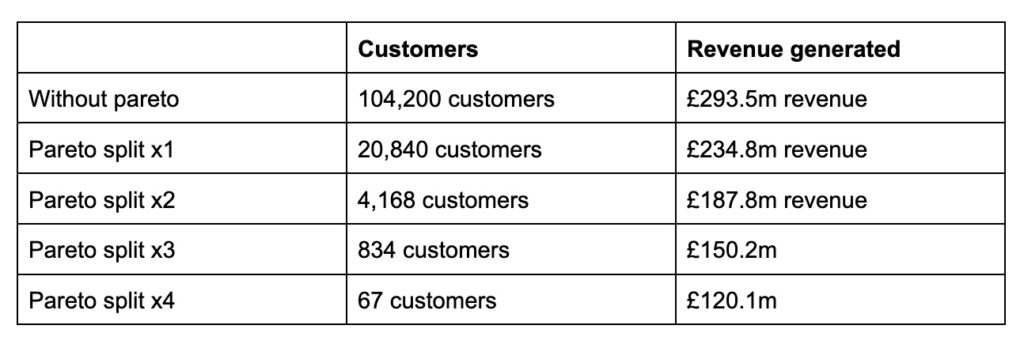
Is this accurate? I don’t know but Capital said 0.16% of UK customers deposited over $1m. If you were to apply the same figure to IG it would be 1,667 customers last year. I doubt that’s exactly the same but it would align somewhat with the figures above.
When you consider that Big Mike Ashley once reportedly lost £200m trading with IG and sales people have been paid multi-million pound bonuses in the past, it makes sense that you would have this huge skew to a small number of customers making the bulk of revenues.

Start hedging with Hantec Prime today
The question then is whether you can actually do anything to attract these people in a meaningful way.
The gambling model is generally to spam the world with huge amounts of advertising and bring in huge customer numbers, knowing that you’ll ultimately get a few that generate most of your revenue.
Another way of thinking about it is to go after high value customers because you can find and target them.

Make mobile your edge with DXtrade
Way back in 2018, this was the strategy of CMC Markets. After ESMA and the FCA decided to try and kill the industry, CMC said it would launch ‘Project Tuna’ to attract higher value customers.
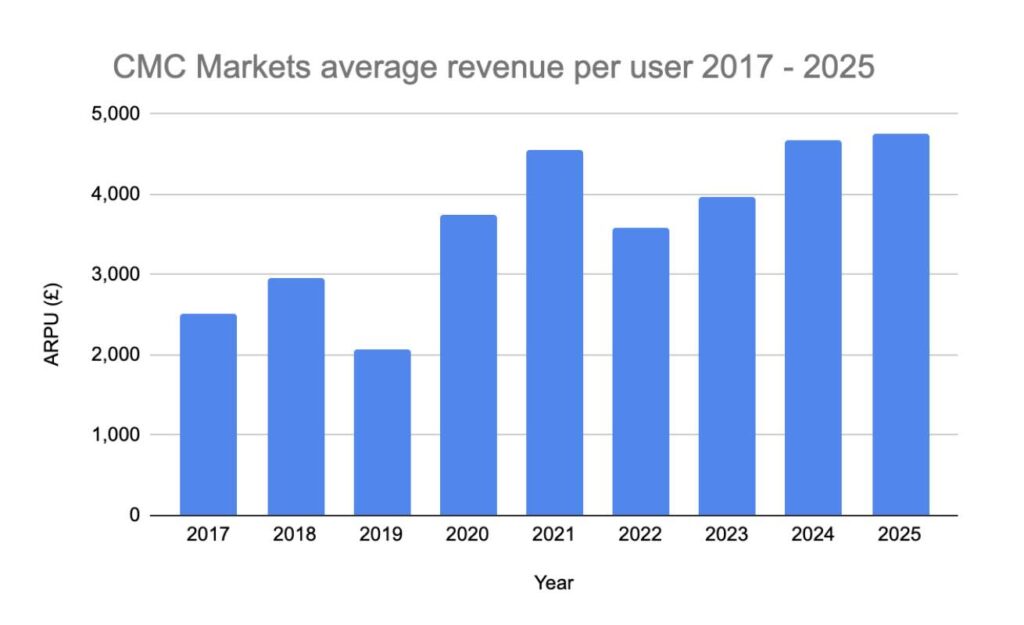
Project Tuna began in 2018, although the company hasn’t mentioned it for a while – there is no mention of any fish in the latest annual report sadly.
You can see that in 2018, ARPU was £2,964 and in the broker’s most recent financial year – which ends in March – it was £4,761.

Give your prop firm a-book liquidity with FX-Edge
However, adjusting for inflation with the Bank of England’s inflation calculator, £2,964 in 2018 would be just shy of £4,000 today. When you factor in randomness and market volatility, it’s not really clear there was a big uplift to the proportion of wealthier clients trading with the firm.
Ultimately getting people in is probably more of a balance of spam and brand. You can spam the world with a lot of ads but also do things to make yourself seem more fancy and legit.
Capital is good at this. If you look at events they attend and sponsor in the UK and MENA, for example, they tend to include politicians and bigger financial institutions (and of course legendary events like FinMark Summit.)
But at the same time, they are extremely good at large-scale marketing.
You can see the balance they strike at the moment. They are currently doing spam on the Investor’s Chronicle website, a UK investor magazine that’s owned by the FT. They’ll get lots of viewers but it’s still a ‘high brow’ publication.
Overall getting big customers feels similar to the underlying business. Brokers can put themselves in a great position to make a lot of money when markets blow up. But when that will actually happen is impossible to say.
Similarly, you can put yourself in a position to get lots and lots of customers but it seems very hard to only pick big hitters. Maybe you need all those sardines if you want to get some tuna?