

For modern brokerages, the definition of a CRM has shifted. It is no longer just a database of names and emails; it is the operational operating system of your business. As we move into 2026, the market is punishing operational friction and rewarding speed.
For brokers evaluating their tech stack this year, “good enough” is no longer sustainable. Here are the four critical trends shaping the industry.
1. The Rise of the “Unified Command Center”:
The Trend: The days of “Portal Hopping” are over. In 2026, efficiency is measured by how few tabs your team needs open. Brokers are moving away from disconnected silos (separate logins for CRM, PSP, and Trading Platforms) toward unified interfaces.
What to Look For: Demand a system that acts as a single source of truth. You shouldn’t just “see” data; you should be able to act on it. Look for a central hub that allows you to change leverage, update groups, and approve withdrawals instantly without ever logging into a trading platform server or payment gateway.
2. The Era of “Always-On” Automation:
The Trend: The most successful brokers in 2026 won’t be the ones with the biggest sales teams, but the ones with the smartest logic. The trend is moving toward “Zero-Touch” Operations, where manual intervention is reserved only for high-value exceptions.
What to Look For: Your CRM must be able to think and act on your behalf 24/7. This requires a dual-layer automation engine:
- The “Reflex” Layer: Simple to use “If-This-Then-That” logic for instant reactions
- The “Journey” Layer: Complex, time-based nurturing sequences that adapt to client behavior
3. Visual, No-Code Onboarding
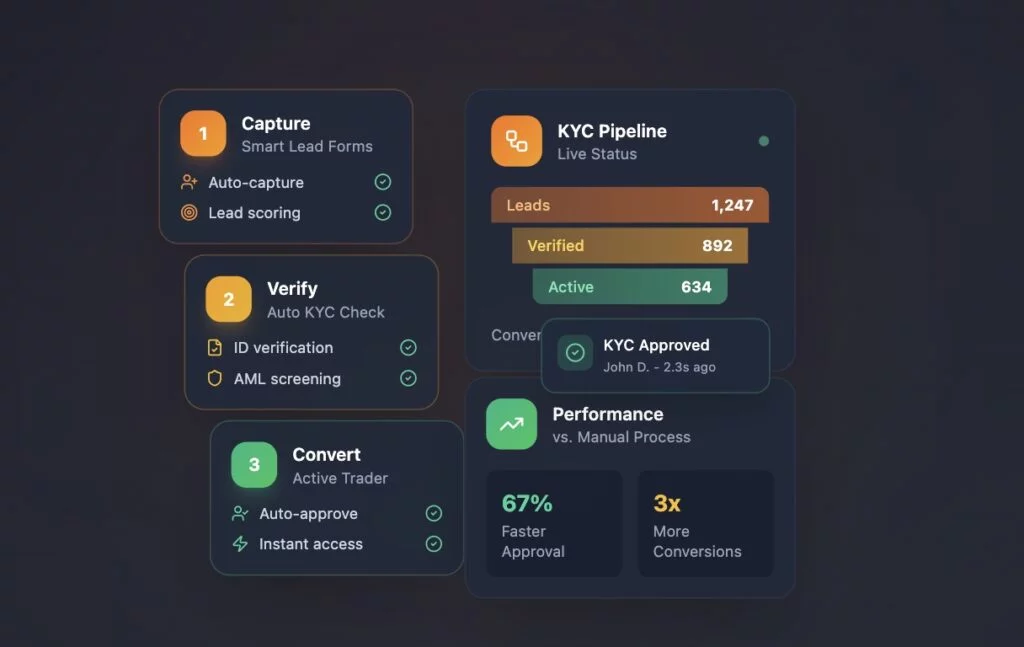
The Trend: Hard-coded onboarding flows are obsolete. Regulatory requirements change too fast for manual dev cycles. The winning brokers in 2026 will be those who can A/B test a new KYC provider or signup flow in minutes, not months.
What to Look For: Prioritize No-Code Customization. You need a visual builder that lets you drag, drop, and customize screens. Whether it’s routing high-risk clients to enhanced due diligence or creating specific flows for different licenses, your Ops team should be able to build it visually without engineering support.
4. The “Engineered for Ops” Ecosystem
The Trend: Integration is no longer just about “connecting”; it’s about “orchestrating.” The trend is toward ecosystems that come pre-integrated with the giants of the industry—SumSub, Stripe, MetaTrader, cTrader—so you can plug and play.
What to Look For: Prioritize Plug-and-Play Agility and Zero-Maintenance APIs.
- Vendor Swapping: If you need to switch KYC providers or add a new local payment method, it should be a configuration setting, not a 3-month development project.
- Resilience: Look for a partner that manages the API updates for you. When MetaTrader or Stripe updates their protocols, your CRM should handle it in the background so your operations never miss a beat.
How TradeCore Defines the 2026 Standard
We built TradeCore specifically to address these shifts. We don’t just provide software; we provide an Operational Advantage.
- Unified Command Center: We sync CRM, Payments, Trading, and KYC in real-time. View live trades, payment ledgers, and document status in one profile—no more tab switching.
- Engineered for Ops: Our Automation Engine handles over 100+ triggers. From “If-This-Then-That” rules to complex retention sequences, the system runs your playbook 24/7.
- The Signup Flow Builder: Our drag-and-drop canvas lets you design high-conversion onboarding journeys and deploy them instantly—zero code required.
The full Ecosystem: With 100+ triggers and 200+ actions, our automation engine handles everything from retention alerts to document renewals on autopilot.