




A judge once said about the oligarch Boris Berezovsky that he “regarded truth as a transitory, flexible concept, which could be moulded to suit his current purposes.” Sounds oddly familiar?
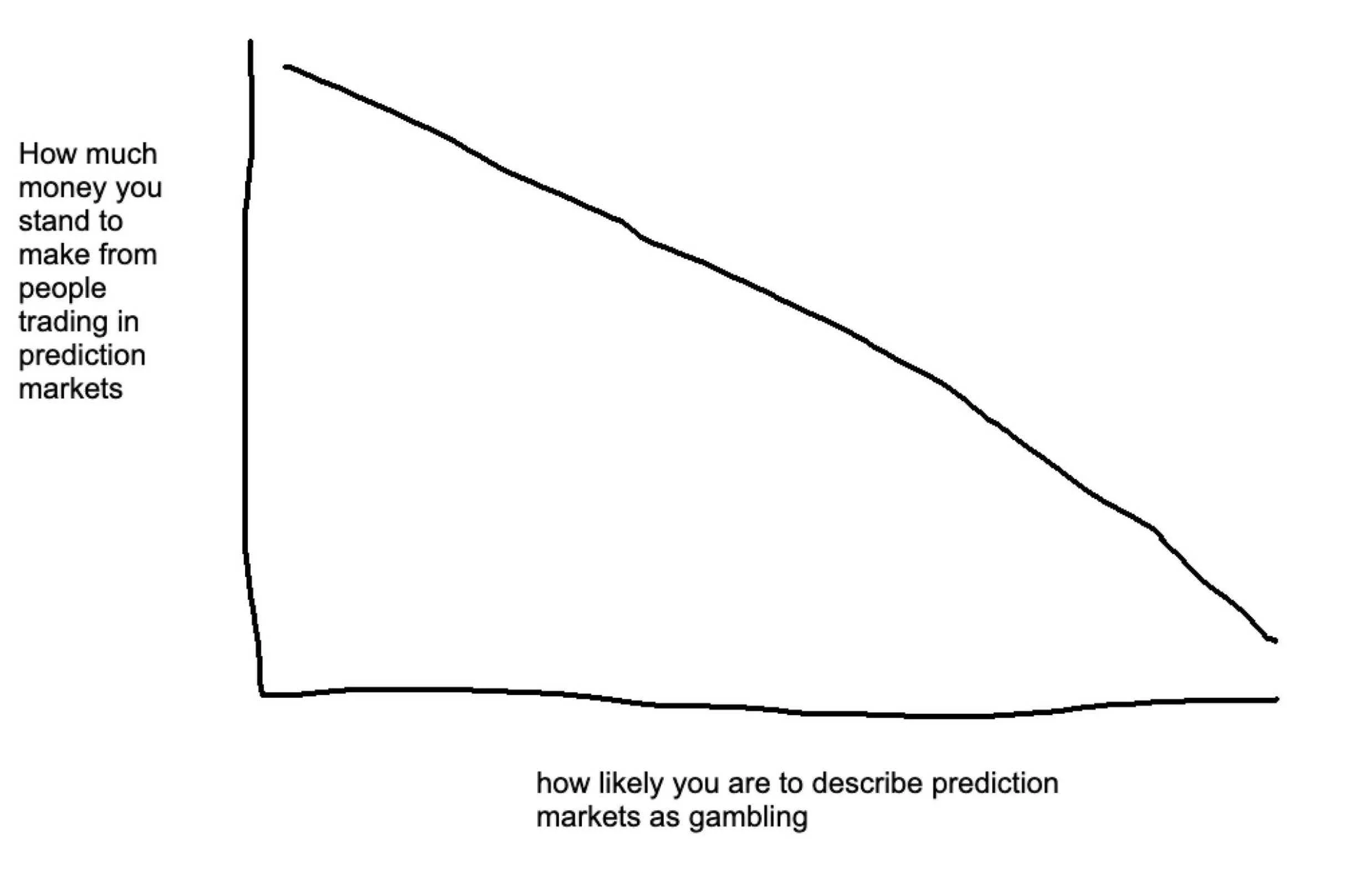
We’re all a bit like Berezovsky though and this is something you can see in prediction markets. Basically how much money you could make from them determines how likely you are to think it’s gambling. We illustrate this in the chart below.

I for one am still making up mind. On the one hand, brokers could start adding prediction markets and make money from them. In that case, I think they are a fascinating new derivative product, providing ‘wisdom of the crowd’ at scale and giving us real time insights into where the future of our planet lies.
On the other hand, you might not be allowed to offer them outside of the US. In that case I would have to say that I’m shocked and appalled by them. I mean we can all see these are just a form of reheated binary options, which people are using to gamble with. Let’s see where the land lies and we can all adjust our ethics accordingly.

My sense is that it will be more of the former. Devexperts, Leverate, and Match-Trade Technologies all have a predictions market product now. More importantly, we are also seeing providers going offshore to offer them.
Currently there seem to be four major prediction markets that operate this way. I would note that they are all ‘pure play’ companies. None of them are tacked on to an existing provider, in the way that brokers would likely offer the product.
| Company | Location | Funds raised | Significant investors |
|---|---|---|---|
| Predict.fun | BVI | Unknown | Binance founder family office |
| Myriad Markets | Cayman Islands | Unknown | Owned by DASTAN, owner of crypto media outlet Decrypt |
| Limitless | Panama | $10m | Coinbase Ventures |
| Opinion | Panama | $20m | Jump Crypto (crypto arm of Jump Trading) |
The first obvious observation to make is that these companies all come from more of a crypto background and most of their financial backing has come from that sector too.
A lot of cryptocurrency exchanges, like Binance, OKX, or ByBit, historically operated in an extremely opaque way. For example, no one even knew where the holding company that owned Binance was for a long time.
They would then do pure offshore business and not really do the whole ‘getting licensed’ thing. To top that off, they then make it very hard to really find out any information about the company. For example, even if you are on a lower quality CFD broker’s site, it’s extremely unusual that they won’t have any bottom of the page disclaimer saying where they are registered. Crypto companies still do that all the time.
All of the prediction markets companies listed above remind me of this ‘modus operandi’. If you go on their website, it’s not clear who owns the business, where they’re based, and so on. Opinion, for example, seems to be the biggest of the four, at least in terms of volume. The CEO is called Forrest Liu but that’s basically it. We don’t know what he looks like, where the company’s main office is, or who works there.
So that’s what these companies look like they’ll do as well. They’ll operate offshore with extremely lax controls and, like crypto exchanges before them, start to become more ‘legit’ as time goes on and regulation forces them to.
In terms of revenue, we reported on Limitless at the end of last week, with the company’s CEO saying the firm made $10m in “annualised revenue” in February, with over 60,000 active traders. This is typically a start up propaganda phrase where you take the money you made in a given month and assume you’ll make that for a calendar year. So they presumably made around $833,333 in February.

In terms of geos, it’s probable that they are all partly targeting China but that won’t show up in Similarweb tools. One country that does seem to be particularly popular is South Korea. You can see where they are getting traffic from, based on Similarweb data below.
| # | Predict.fun | Limitless | Opinion | Myriad |
|---|---|---|---|---|
| 1. | Russia (17.3%) | Pakistan (29.4%) | Ukraine (11.0%) | S. Korea (31.8%) |
| 2. | S. Korea (10.9%) | Canada (13.5%) | Russia (8.1%) | France (8.9%) |
| 3. | Czech Republic (10.6%) | USA (12.4%) | USA (7.7%) | Vietnam (7.9%) |
| 4. | Ukraine (9.0%) | S. Korea (9.1%) | Germany (7.2%) | USA (7.2%) |
| 5. | USA (6.7%) | Brazil (6.9%) | Japan (6.9%) | Pakistan (6.7%) |
Limitless has a whole section on South Korea on its website. I’m not really sure why that’s the case, other than to attract and cater to customers from the country.
The final point I’d note is that I think Myriad has an interesting take on the product…
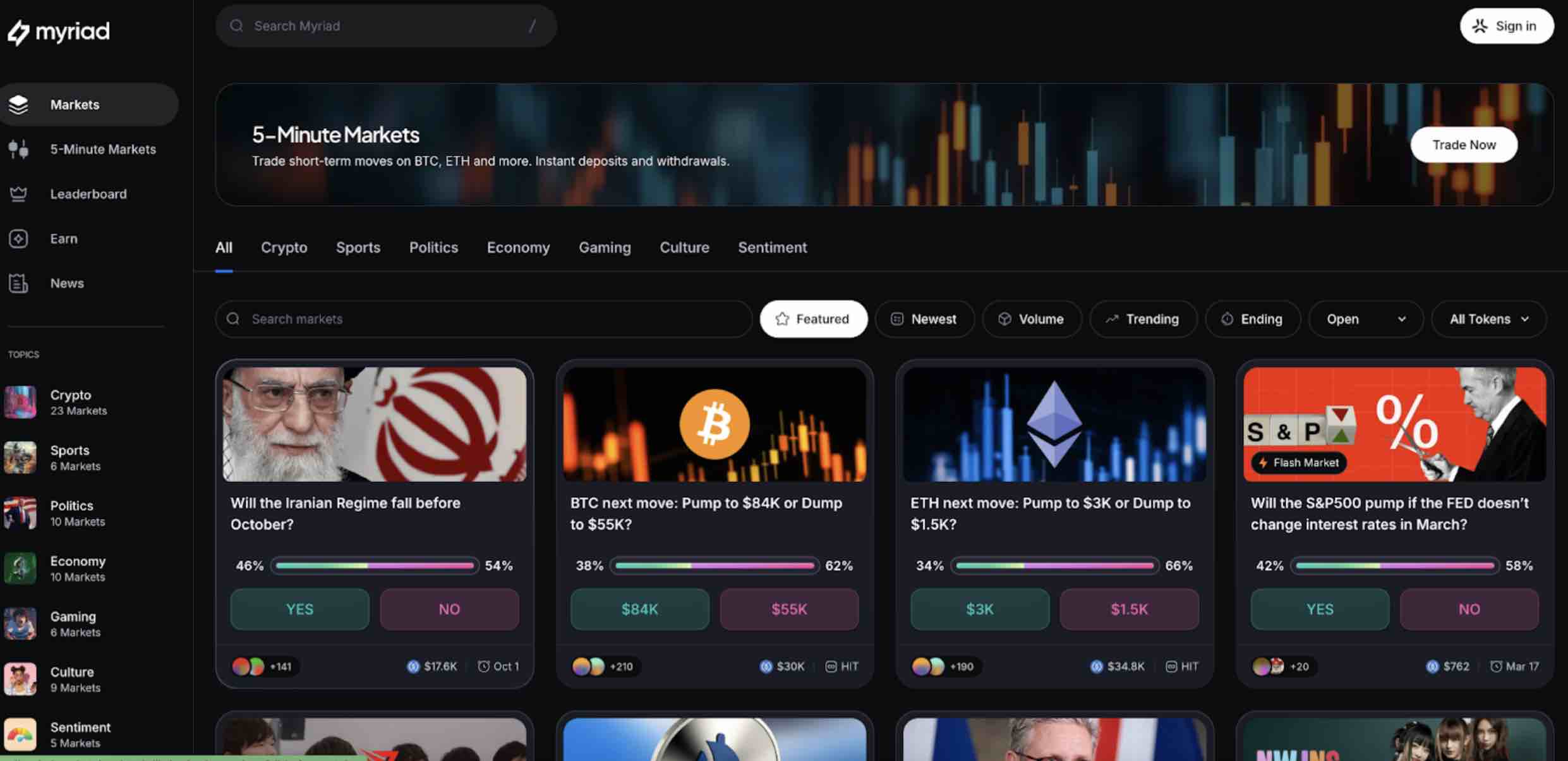
As you can see, the main push at the top is to get you into ‘5-minute markets’. There is a section on the left that pushes you to do the same. Why are these better markets to get people to trade? Because you can market make on them and take the other side of trades. Unfortunately you can’t really do the same on whether the Iranian regime will fall before October.

That’s also the model I would suggest brokers take. Ultimately prediction markets are good revenue generators but not in the same way that OTC products are. But you can make them into an OTC product by copying what Myriad is doing.
There is another factor at play here as well, which is brand. We looked at Plus500’s offering for prediction markets in a short video last week. They don’t offer sports and instead focus on financials and politics. My guess is this would be more on brand for other brokers as well.