



- How do you start a prop firm?
- What are the differences between running a prop and a broker?
- What are props doing today that makes them money?
All this and more in this month’s cTrader webinar!
We’ve looked before at some of the payment statistics that props publish and how…well they don’t often seem to line up with reality.
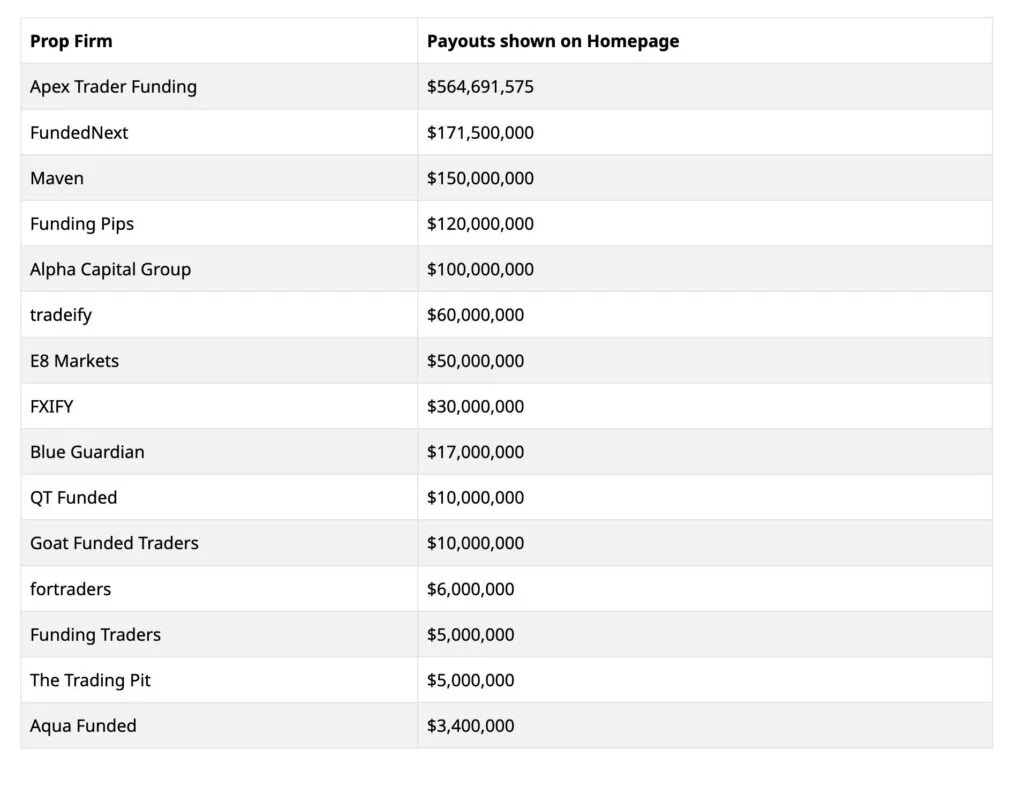
Earlier this week, Christian Görgen, the Founder of marketing agency FYI, published a list of the 15 biggest payouts from the prop space.
You can see the table below, which I’ve copied from the website.
There isn’t that much that’s new here as we went through a lot of the numbers in the previous article.
A company that does stand out though, and which we didn’t look at before, is Apex Trader Funding because of how insane its total payout claim is.
Apex was launched in 2021 so the total figure of $564,691,575 is spread across a roughly four year period. You would assume there was some growth over time, meaning payouts were not the same each year, but rather rose in each one.
We can’t know what that growth was because the company is private.
Taken as a whole though, we do know that payouts tend to be around half – give or take – of total revenues.
So in practice that would mean Apex Trader Funding earned over $1bn in revenues in the last four years. No that didn’t happen.
The thing I do like about this is how oddly specific it is. Why stop at $564m? Why not make it $1bn or even $1trn? Is there a random number generator or do you have a specific system in place to invent payout numbers? I guess it’s an exercise in how far you can stretch credulity.
I remember talking several years ago to a lawyer in this industry about ads that involved fake celebrity endorsement, usually for FX trading but also gambling.
“Yes, it’s unethical,” he said. “But it’s not illegal”.
Is that the case with this stuff?
The thing about Apex Trader Funding is it is a US firm and, although it may not be breaching financial regulations, it could be breaking rules around marketing and consumer protection.
Over in the US, the Federal Trade Commission (FTC) has gone after several trading education companies that missold courses and other materials to investors.
In one case against IM Mastery, the FTC noted that….
it is an unfair or deceptive trade practice to make false, misleading, or deceptive representations concerning the profits or earnings that may be anticipated by a participant in a money-making opportunity
If you look through that case, those claims are not that specific. This is not someone saying they made a 40% return in one month using a trading robot. It’s more like ‘I became a millionaire from trading and bought my mum a house’.
My guess is that US regulators don’t like this industry and are mad that they absolutely butchered their own case against My Forex Funds. It doesn’t seem implausible they could use the FTC instead.
Anyway, let’s take the cynic’s approach and ask why prop firms would do stuff like this anyway?
The obvious answer is that it works. Whether we like it or not, people find the allure of fast money more appealing than some FCA-boilerplate text about how risky trading is.
Given that’s the case, there are always going to be people who are willing to take the risk and use it in their marketing materials.
The other point is that stuff like this has gone on for ages in the brokerage space.
For example, there are loads of firms who will describe themselves as ‘ECN’ and/or ‘no dealing desk’ brokers.
Then you do a quick Google search and you find that they have a Head of Dealing. I guess this points to a wider problem of marketing, which is where do you draw the line between what is ‘ok BS’ and what is ‘not ok BS’.
I remember a few years ago going to meet one affiliate at the company I was working for at the time.
Prior to going my assumption was that they had some knowledge of the product and what it did. After we went and they loaded it up, it was obvious they had absolutely no clue at all. A few minutes later they were promoting it on camera.
This was for a really vanilla product, so I guess there was nothing too wrong with that? But ultimately it was BS – they were shilling something they knew nothing about and making it sound awesome.
Payouts ultimately serve the same function. It builds hype and it gets people excited. I guess for props they have to adopt the George Costanza approach to life – it’s not lying if you believe it’s true!