

Reach over 8m traders with cTrader today
Back in July we got some data from the teams over at Swiset and FXStreet about prop customers and – at long last – we have gone through it.
The study looks at a bunch of information but the key points for me were around what people are buying and where they are based. Information like this is always interesting as most props are opaque and privately run, so it’s not easy to get insights into what’s going on behind the curtain.
Trader activity was analysed across every continent, with purchases broken down by account size and type.
Although the study skewed towards customers in Latin America, we’ve adjusted the numbers to reflect what proportion of people in a specific region were buying.
The first observation to make – which is probably not that surprising – is you can see how lower income countries tend to have a larger proportion of lower value challenges as a percentage of overall purchases.
For example…
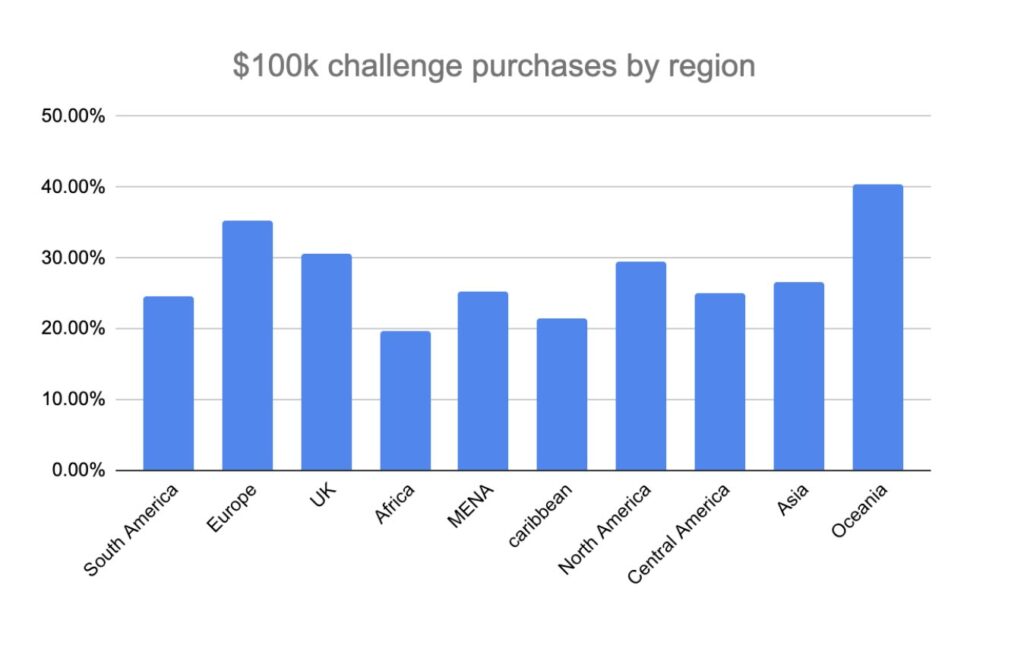
These are $100k account challenges broken down by region. For example, just over 40% of all the customers from Oceania bought $100k accounts. In Africa it was less than 20%.
You can contrast this with smaller value accounts, which were less popular in wealthier regions and a lot more popular in lower income regions.
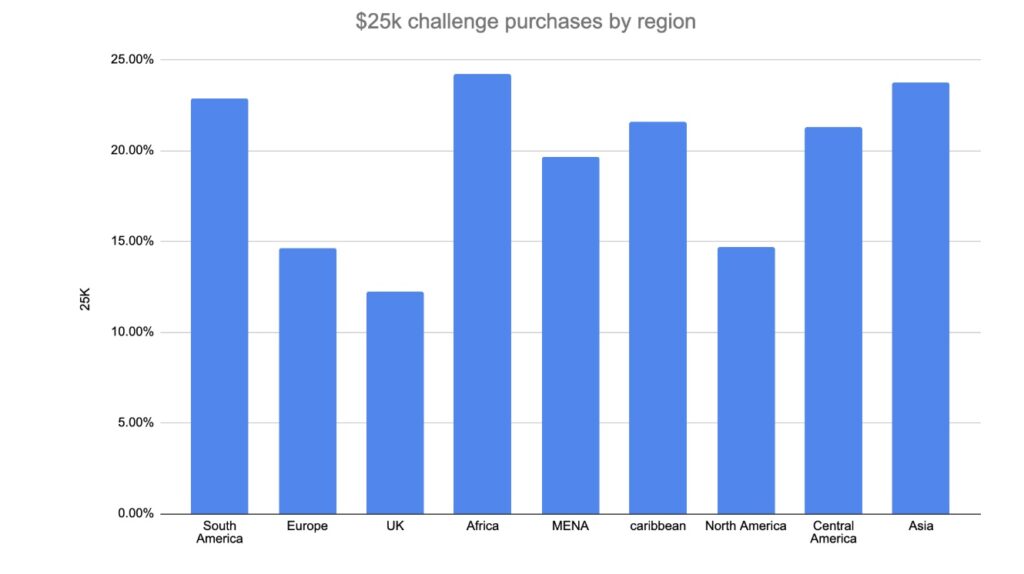
One point I’d note here is that if you were to use income levels as some kind of proxy for what you’d expect people to buy, you could argue that people in places like LATAM and Africa are actually buying more higher value challenges than you’d expect.
What I mean by that is using per capita GDP as a crude measure, Europe’s average income is often 10x to 20x the equivalent for African countries. And yet Africans are buying half as many $100k challenges, rather than 5% to 10% of the amount.
If you consider that in these markets, populations are larger and there is more of a volume game to be played, it’s not necessarily the case that you should target customers with lower value challenges. They may buy fewer higher accounts sizes proportionally but you have many more customers and consequently more ‘real’ purchases of those accounts.
When you then factor in lower customer acquisition costs in these markets, it can make more sense to keep targeting higher value accounts in them.
The next interesting tidbit of information was on account types.
I would have assumed more people would buy instant funding accounts, rather than two-step or one-step accounts.
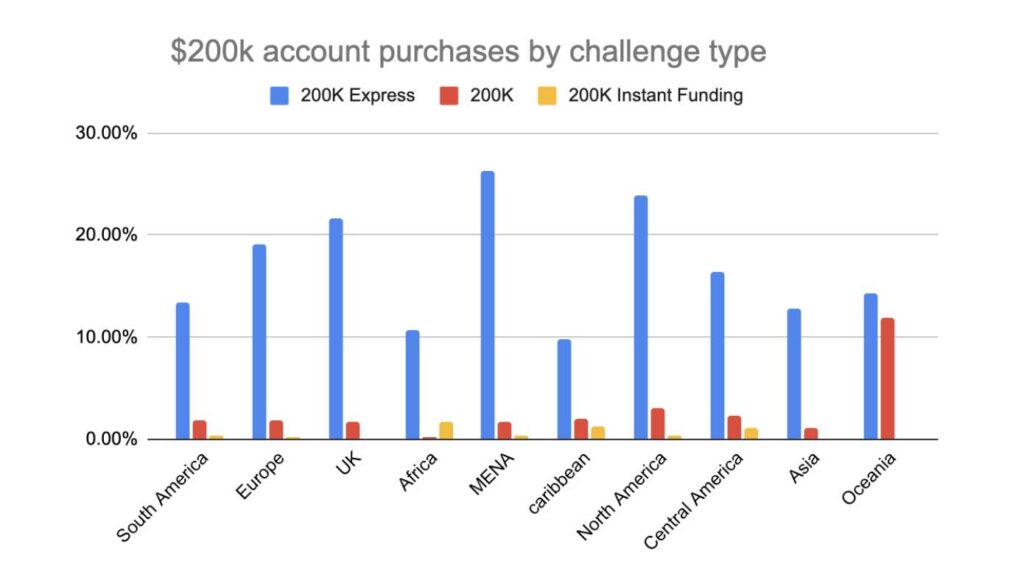
However, the FXStreet x Swiset report shows the most popular challenges appear to be ‘Express Funded’ accounts.
These are typically accounts that have some sort of speedier access to funding but still require you to pass a challenge before you get funding.
Interestingly this was true in every region and across the board in every challenge. My assumption is that traders want a balance of quick funding and more attractive terms. You can see how it breaks down for $200k accounts below.
Most instant funding accounts come with a much larger number of strings attached to them, given the risk you face as a prop from giving a funded account to someone who is untested.
Consequently it can actually be a better option as a trader to try getting a funded account via a challenge, when you’ll have more attractive terms to trade under if you get to the funded stage.
Another interesting piece of information is what people are actually trading. The top five instruments were…
1. US Tech 100
2. USDJPY
3. XAUUSD
4. BTCUSD
5. EURUSD
I guess people don’t change – this is what we have on the TradeInformer website for swap rates on the most popular instruments, with the tech 100 being the only different one.
I think this is actually a ‘positive’ for props in that it shows you have the same sort of client as in the broker space. It is people looking for volatility to see if they can make some money quickly.
The only potential problem here would be gold – mainly because you have arbitrageurs in that market who can really hit you – something we’ve looked at before in this newsletter.
On the other hand, knowing this can be a useful marketing tool. For example, Instant Funding recently did a gold trading tournament, presumably because that’s because they can see what their customers like trading.
The final interesting point in the report was what was the most profitable instruments for traders.
Weirdly, three of the top five were Canadian dollar currency pairs. The other two were the Nikkei and the Dow Jones index.
I don’t know what to make of that?
Crews of Canadian scammers out there in the ether.