
CFDs account for more than a third of the portfolio value of those who trade them on multi-asset apps.
That’s according to research from the Financial Conduct Authority (FCA) published in April last year, drawing on a wide sample of consumer data from trading apps. The data was collected between November 2021 and November 2022 and only concerns UK investors with a minimum balance of at least £100.
The paper was not widely reported on at the time. Its focus is on digital engagement practices (DEP), or gamification.
Its findings led the FCA to publish a discussion paper last month warning that firms should not push savers into higher-risk instruments.
But there are a number of other interesting insights into trader behaviour in the data, including regarding conversion rates on multi-asset apps from lower risk to higher risk products.
Among them is that, for investors who bought CFDs, such products made up an average 36% of the portfolio value on the apps which offer the products and 33% of their total portfolio across all their accounts.
On apps offering CFDs, 1 in 5 customers (21%) traded them.
There was no direct data on the specific types of CFDs traded – although this can be inferred somewhat from the data the FCA revealed.
Two thirds of multi-asset app users trade crypto
Two thirds of users (67%) traded or held cryptoassets on multi-asset trading apps.
Among crypto traders, on average these assets accounted for 63% of their total portfolio value on these apps, and 56% of their total portfolio across all their accounts.
In total, 38% of investors with accounts on apps offering both CFDs and cryptoassets held 90% or more of their portfolio value in these products.
On average 68% of their portfolio value on these apps was accounted for by these instruments and 62% of their total portfolio across all their accounts was in these products
For crypto traders the most popular assets were Bitcoin (traded by 42%), Cardano (37%) and Ethereum (36%).
14% of high-risk trading app users invest more than £10,000
Among high DEP investors – on trading apps typically offering more high risk products alongside gamification – those that used CFDs had portfolios on average twice as large as their peers that did not use CFDs.
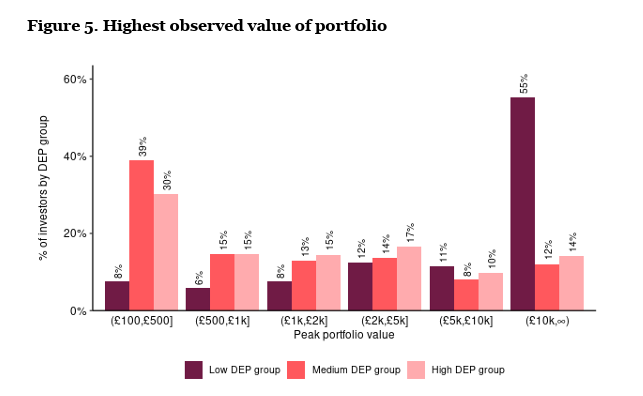
On high DEP apps, 14% of users had portfolios valued at more than £10,000. This fell to 12% on medium DEP apps.
As might be expected, this rose to more than 55% on low DEP apps, which include the larger stockbroking platforms that typically only offer savings and pensions products, and not high risk instruments such as CFDs and crypto.
On high DEP apps, the share of CFD users active six or more days a week was 8.5% on average, with 16% averaging 10 or more trades a month (the overall average was 8.3 trades). Nearly two thirds day traded at least once.
Among active traders, the average length of time on a single app was 3.3 years and the average portfolio size was £31,806. However, the median was 2.3 years with a portfolio value of £2,656.
Nearly fourth fifths (79%) of active traders were men. The median age was 36 and the average age was 38.
20:1 leverage most popular
Among CFD traders, the median leverage was 10:1, or capital worth 10% of the size of the position. Only 17% of total CFD trades were made with this leverage, however (see chart below).
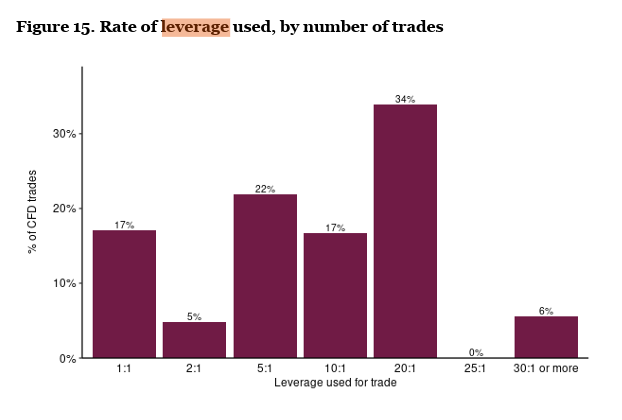
More than a third of CFD positions (34%) were opened with a leverage of 20:1 (capital at 5% of position size) which is indicative of trading in commodities and indices.
Only 3.6% of investors who had access to CFD products opened at least one position with that much leverage
Trades made a leverage of 30:1 (capital at 3.3% of position size), restricted to FX instruments, accounted for 6% of the total.
CFDs traded at a leverage of 1:1 – or no leverage – accounted for 17% of total transactions.