
Cyprus has maintained its dominant position as a hub for international retail brokers, despite increasing competition from other regions.
As of 21 January, the country saw firms hiring for four times as many new jobs as its closest competitor, the UAE, according to data shared in a report by forex broker marketing consultancy FYI.
While the data was primarily sourced from openly advertised roles shared by firms on LinkedIn and other jobs boards, and so may not be fully representative of hiring activity in the broker space, it still indicates that Cyprus is far from being unseated from its key role for the industry.
The Mediterranean island nation accounted for 22.8% of 1,430 open roles last month, or 326 in total. By contrast, roles posted in the UAE made up just 6%.
This is despite much interest in the UAE’s expansion as a financial centre in recent years, and Cyprus no longer being the default place for firms to get a new regulatory license.
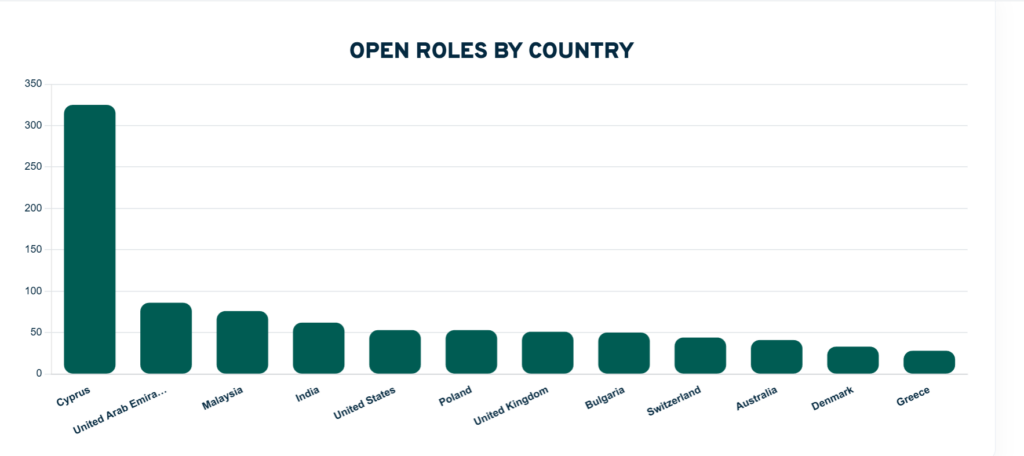
Malaysia took third place, with 5.3% of jobs advertised in the South Asian state. This was followed by India and the US.
When it came to the type of staff in demand, engineering and technology took a clear lead, with 29% of open roles in this category.
Python, Excel, and SQL were the most in-demand skills, according to the report.
That was followed by marketing, sales and support roles, which made up roughly equivalent fractions of the total, at 10-11% each. Compliance was the least in demand, at 4%.
The bulk of openings were situated between the junior (1-2 years) to experienced (4-6 years) level, with few entry-level or very senior positions being advertised.
Interactive Brokers leads hiring
Among specific firms, US-based Interactive Brokers came top in the number of current job openings, at 136.
Cyprus-headquartered HFM and XM came second and third respectively, with around 100 and 90 roles open.
Cyprus-based Capital.com had 81 open roles, while Switzerland-based Swissquote took fifth place with 67 openings.
Other interesting insights from the report included that firms had reduced some of the benefits they offer employees, with housing, cars, gym membership “a thing of the past”. On the other hand, 12.3% of roles were advertised as fully remote.