
TradeInformer has learned that Warsaw-listed broker XTB has been subject to a systematic legal and public relations campaign to stymy its entry to the Brazilian market, with the key supporters of that campaign being local exchange B3 and investment platform XP.
In its latest regulatory filings, released at the end of October, XTB said that it was considering pulling out of Brazil due to what it described as “local protectionist measures”. However, the firm did not go into more detail as to what those measures were. The broker has since stopped onboarding clients in Brazil.
We now understand that B3, a local Brazilian exchange, has played a key role in attempting to block XTB’s efforts to enter the market.
That has included using paid media to attack foreign brokers, like XTB. One of those campaigns involved B3 hiring an IB, who had worked for XTB previously, to work on a paid advertising campaign, highlighting the supposed ‘dangers’ of forex trading.
In an article published in Brazilian outlet Valor Investe in August of this year, B3 executives even told a local journalist that they are “supporting the CVM’s crusade against platforms that operate irregularly in Brazil”. Although the word “irregular” is used, we would note that most CFD platforms are not doing anything irregular in the country. XTB, for example, was working with a locally regulated partner and trying to get approval from Brazilian financial authorities to operate in the country.
The reason for B3’s advertising and public relations campaign is that the exchange has been shedding active traders since the pandemic peak of 2021. According to the article in Valor Investe, the number of active derivatives traders on the B3 exchange fell from 568,000 in 2021 to 332,300 last year, with the potential for a further decline this year.
A B3 executive told the outlet that they believe most of the active traders they want as customers are using CFD brokers instead. Consequently they have looked at ways to bring them back to the exchange.
Despite the supposed benefits of exchange trading, B3’s own research shows that close to 75% of its derivatives customers lose money. This is worse than the statistics or in line with the current statistics published by several UK-regulated brokers offering CFD trading, including IG Group, CMC Markets, and eToro. It is also worse than the CFD loss statistics for XTB’s UK and Polish entities.

At the same time as this has been going on, TradeInformer has also learnt that XP – a local broker in Brazil – has been waging a legal battle against XTB and other brokers that have accepted Brazilian clients.
Documents seen by TradeInformer show that XP has filed dozens of legal complaints to the local regulator about CFD brokers. That includes at least one complaint against XTB itself.
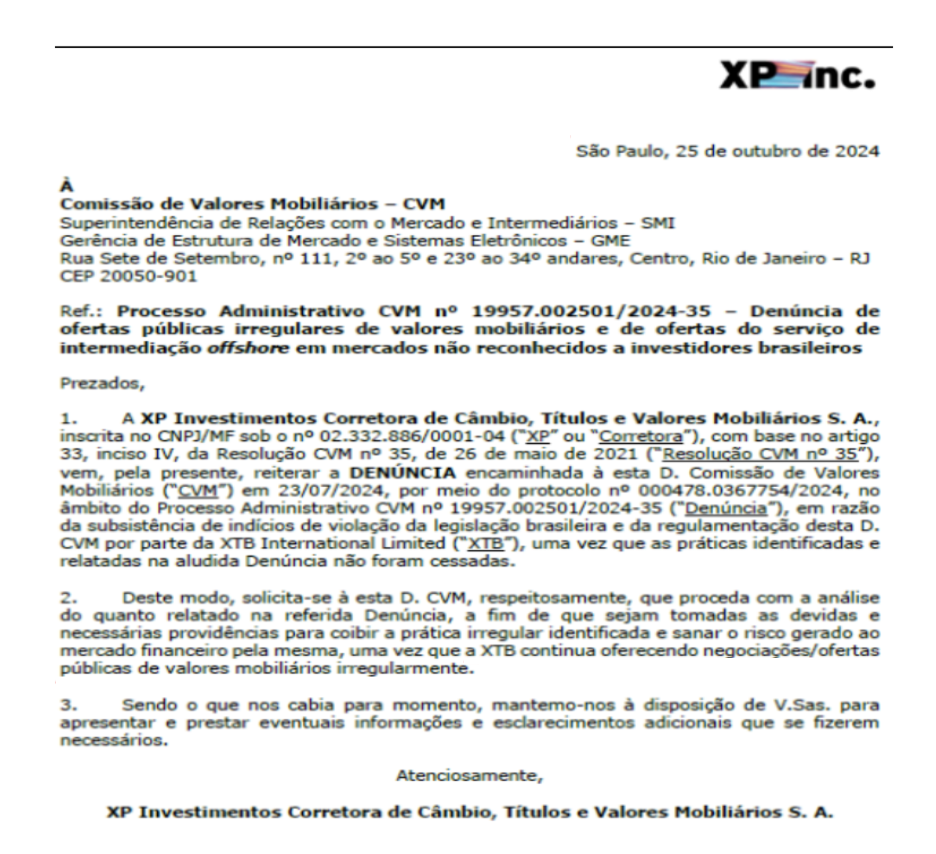
In the document, which you can see a screenshot of above, XP says that “XTB continues to carry out irregular public offerings of securities” and asks the regulator to take steps to stop them from doing so.
It’s also worth noting that this complaint is itself a follow up to a prior complaint. A person familiar with the matter told TradeInformer that the goal of XP’s legal complaints is not to necessarily to win each case but to slow down, block, and hinder the ability of other firms to compete in Brazil. XTB was more likely to be impacted by this activity as it was in the process of attempting to get a local license.
The complaints by XP are in line with other activities at the broker. Over the last five years, XP has faced multiple complaints about its anti-competitive practices in the Brazilian market.
More specifically, the firm used different contractual agreements and other logistical methods to block individual traders and investment advisors on its platform from moving funds to other providers.
One result of that was the Administrative Council for Economic Defense – Brazil’s antitrust regulator – imposed measures to prevent XP from forcing investment advisors to remain on its platform.
The moves by both B3 and XP mirror what we see in other markets, most notably in the US, where exchanges fear the presence of competition from OTC trading.
Exchange bodies, local brokers, and the National Futures Association all worked to block and restrict access to retail OTC trading in the 2000s, because they knew it would lead to them losing business.
Those efforts were largely successful, with the US OTC FX market now tiny in comparison to the boom years which took place from the late 1990s through to the early 2010s.