









 FCA
FCA ASIC
ASIC CySEC
CySEC DFSA
DFSA SCB
SCB CMA
CMA BaFin
BaFinOverview
Pepperstone is a global brokerage business that offers CFD trading across major asset classes, including forex, shares, commodities, indices, and cryptocurrencies. The company was founded in 2010 in Melbourne, Australia, by Owen Kerr and Joe Davenport, and is still headquartered there today.
The broker holds licenses in several Tier-1 jurisdictions, most notably with the FCA in the UK, CySEC in Europe, and ASIC in Australia. Because of this strict oversight, the firm has earned a strong reputation for safety and is generally viewed as a secure, respected partner for online traders.
Clients can access the markets through various third-party platforms, including TradingView, cTrader, and the MetaTrader suite, alongside the broker’s proprietary platform. As a global business, the specific products and platforms available to you will depend on your country of residence.
We like the variety of platforms, the broad selection of CFD instruments, and the competitive trading costs. We also value the inclusion of copy trading for those starting out.
However, as a specialist CFD provider, Pepperstone is less suited to those seeking physical share ownership or long-term traditional investments. Pepperstone is also not regulated in Singapore, Malaysia, or Thailand.
Pros & Cons
- Regulated in multiple tier-1 regions
- Low commissions and spreads – best pricing among tier-1 brokers
- Zero deposit / withdrawal fees
- Multiple trading platforms
- Only offers CFDs
- High swap rates
- Not regulated in Singapore
- No strong mobile product
Trust
Pepperstone is regulated in seven countries and holds approvals from several major global authorities. The extensive regulatory footprint, combined with a 16-year track record, makes the firm one of the more transparent and reliable brokers in the industry.
The company is authorized by three Tier-1 regulators: the Financial Conduct Authority (FCA) in the UK, the Australian Securities and Investments Commission (ASIC), and CySEC in Cyprus. These licenses are widely considered the highest standards for financial oversight.
Beyond its Tier-1 status, the broker is also regulated in Cyprus, the UAE, Kenya, and The Bahamas. The strict regulatory requirements compel Pepperstone to hold all client funds in segregated Tier-1 bank accounts.
Regulation
Pepperstone is regulated in seven countries and holds approvals from several major global authorities. The extensive regulatory footprint, combined with a 16-year track record, makes the firm one of the more transparent and reliable brokers in the industry.
The company is authorized by three Tier-1 regulators: the Financial Conduct Authority (FCA) in the UK, the Australian Securities and Investments Commission (ASIC), and CySEC in Cyprus. These licenses are widely considered the highest standards for financial oversight.
Beyond its Tier-1 status, the broker is also regulated in Cyprus, the UAE, Kenya, and The Bahamas. The strict regulatory requirements compel Pepperstone to hold all client funds in segregated Tier-1 bank accounts.
Account Opening
Opening an account with Pepperstone is a pretty seamless experience that usually only takes a few minutes. While the specific Pepperstone entity you sign up with depends on where you live, the actual onboarding process is remarkably consistent across the board. You’ll manage everything through the main pepperstone.com site, where the “Join Now” and “Trade Now” buttons are easy to spot.
Opening an account with Pepperstone
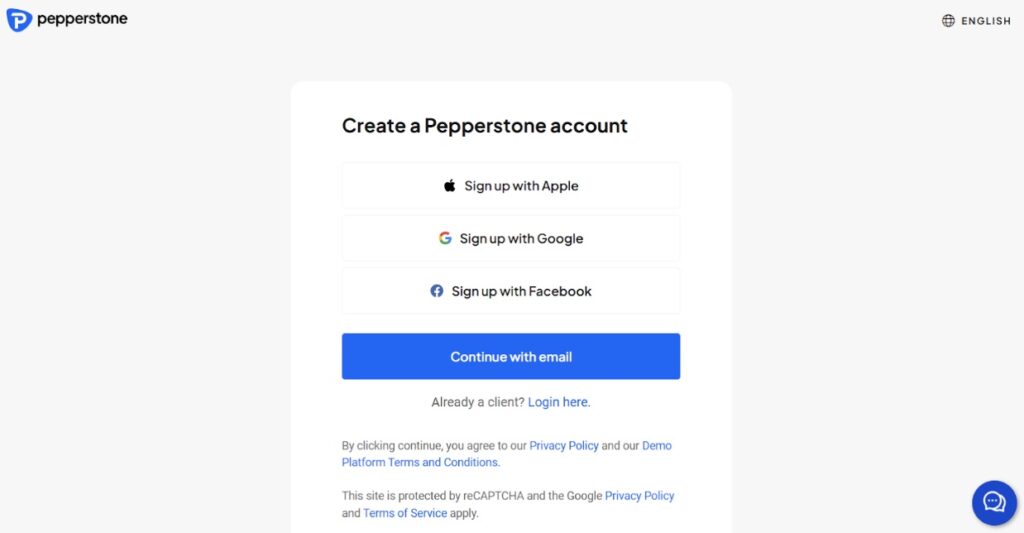
- After clicking the ‘Trade now’ or ‘Join now’ buttons, you’ll be directed to the page below.
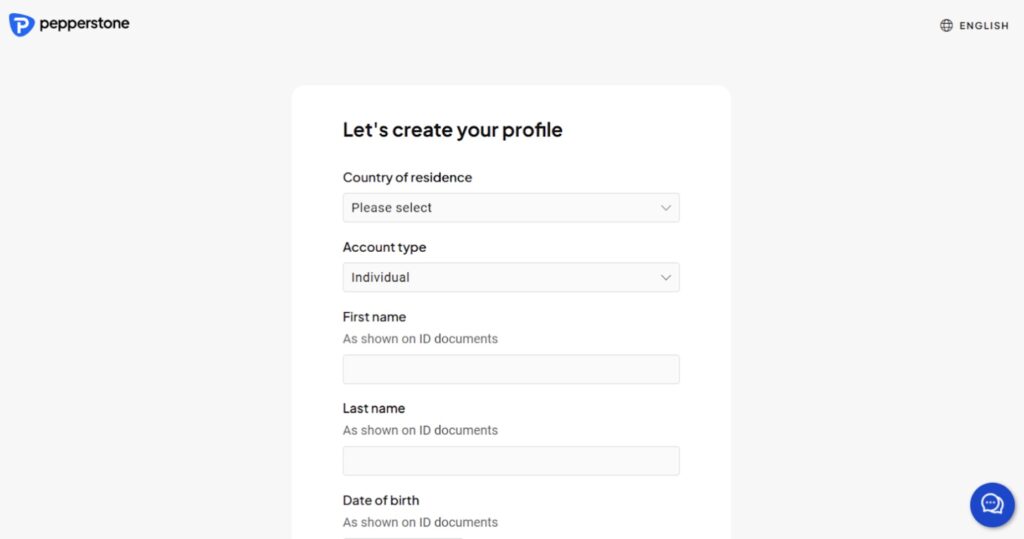
- Next, you will be directed to the profile setup page, where you’ll enter your country of residence and other personal details. Your place of residence will determine the legal entity under which your account will be held.
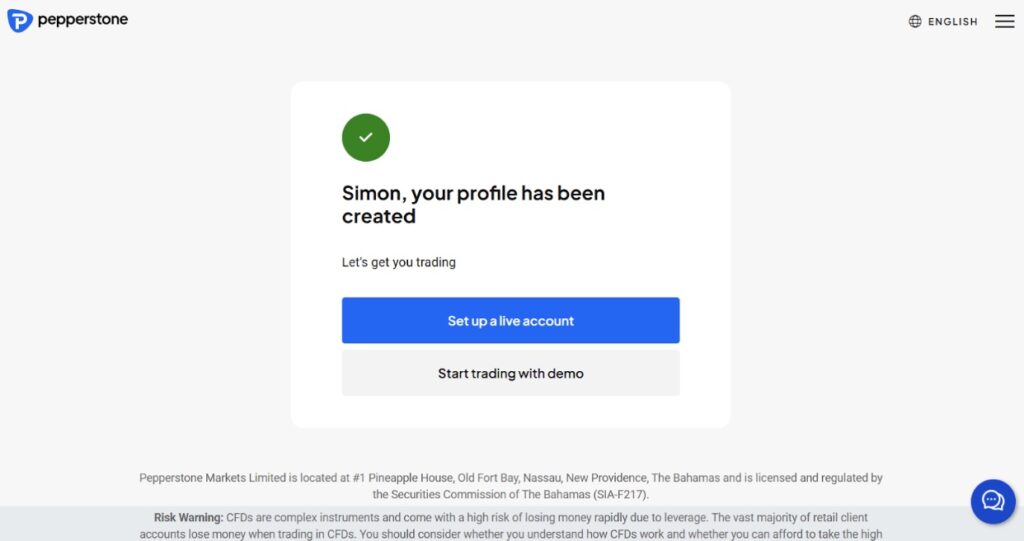
- You’ll then move on to deciding whether you want to open a live or demo account.
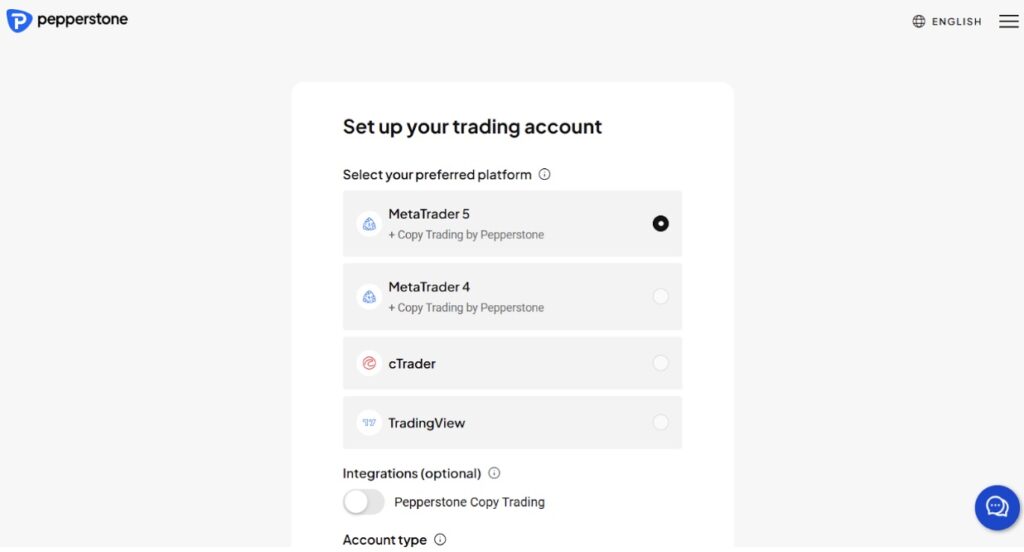
- The next step is to set up your trading account.
- After that, you’ll fill in your employment and income details. Pepperstone uses this data to determine if you have the financial resources and experience to trade CFD products offered.
- The final step involves uploading your ID and proof of address. It’s a standard “know your customer” (KYC) move to keep things secure and meet global anti-money laundering rules.
Trading accounts
Pepperstone gives you two main ways to trade depending on how you prefer to pay your fees, unlike some brokers that offer a one-size-fits-all model.
Standard account
The Standard account is a great shout for newer traders or those who want a “set it and forget it” fee structure. Instead of worrying about separate commissions, all the trading costs are baked right into the spread. It’s easy to manage and keeps your math simple when calculating profits.
Standard Account Overview
Razor account
If you’re an intermediate or advanced trader looking to trim your costs, the Razor account is likely your best bet. It offers “raw” spreads that can hit 0.0 pips, but you’ll pay a fixed commission on each side of the trade. It’s built for those who want to trade with a fixed commission and the potential for extremely tight spreads.
Pepperstone Razor Account
Products
Pepperstone offers over 1,650 CFD products across a broad range of asset classes. Although the broker is widely known for its forex offering, you can also trade commodities, cryptocurrencies, shares, ETFs, and indices. We like that they also provide access to niche products like currency indices and CFD forwards, which aren’t available at every brokerage.
Here is a breakdown of the main products offered by Pepperstone.
CFDs
Unlike some competitors that offer physical stock ownership or managed portfolios, Pepperstone is a specialist CFD provider. This means that when you trade shares or ETFs, you are trading a derivative that tracks the underlying asset’s price rather than owning the asset itself.
This is a great setup for traders looking to speculate with leverage on price movements, without the logistical hurdles of physical ownership.
Forex
Pepperstone offers forex trading in all of its global markets. It is important to note that when you trade forex here, you are trading a “rolling spot forex contract,” which is treated as a CFD in almost every jurisdiction.
Shares
Traders can access roughly 1,400 share CFDs from major American and European exchanges. A unique feature we like is that these are tradable 24 hours a day, five days a week—meaning you aren’t limited by traditional stock exchange opening hours.
Commodities
Pepperstone offers 40 commodity CFDs covering everything from precious metals and energies to soft commodities. They include popular markets like gold, silver, gasoline, and natural gas, as well as cocoa, coffee, and copper. These are available to trade around the clock, providing plenty of opportunities for diversification.
Indices
You can trade over 25 index CFDs with Pepperstone, covering major benchmarks across North America, Europe, Asia, and Africa. Similar to their share offering, Pepperstone allows you to trade dividends for index CFDs, which helps bridge the gap between speculative trading and traditional market exposure.
Cryptocurrencies
Pepperstone provides access to 31 cryptocurrency CFDs, including majors like Bitcoin, Ethereum, and XRP. We think trading crypto as a CFD is a convenient option because it eliminates the need for a digital wallet or private keys. You can also trade on margin and profit from both rising and falling markets.
ETFs
There are over 90 ETF CFDs available, allowing you to profit from the price moves of underlying exchange-traded funds. A key benefit here is the ability to use leverage, which is something you typically cannot do when purchasing the actual physical ETF.
Deposits and withdrawals
What currencies can you deposit with Pepperstone?
Pepperstone stands out by offering a highly flexible range of base currencies for your trading account. This is a key advantage as it allows you to fund, trade, and withdraw in your local currency, helping you avoid unnecessary conversion fees.
Supported Account Base Currencies: Pepperstone currently supports the following base currencies: AUD, USD, JPY, GBP, EUR, CAD, CHF, NZD, SGD, and HKD.
For traders in specific regions, such as Kenya or South Africa, the broker also supports local funding options in currencies like KES and ZAR, which are then typically converted into one of the major base currencies listed above.
How to deposit on Pepperstone
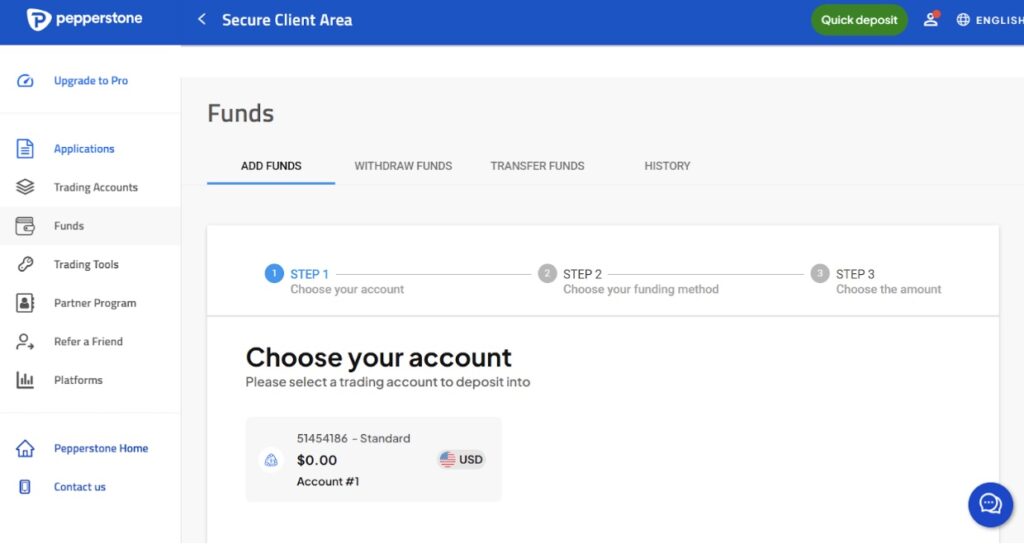
Funding your account is a simple process, whether you are using the desktop client area or the mobile app. To get started, you log into your Secure Client Area and navigate to the ‘Funds’ tab on the left-hand menu.
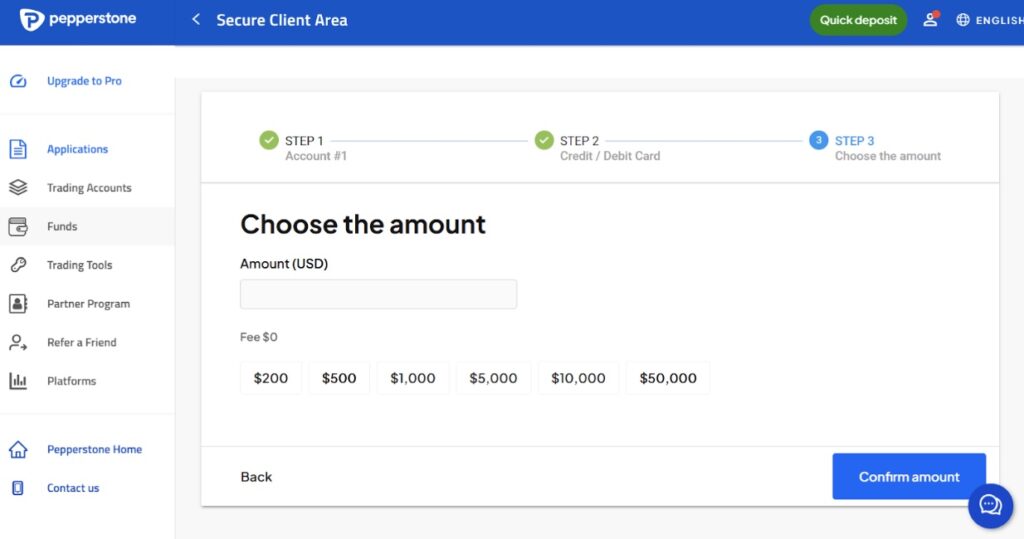
On Desktop: Once in the ‘Funds’ section, click ‘Add Funds,’ select the trading account you wish to fund, and choose your preferred payment method.
- Begin the deposit process in the client portal
- Choose your funding method
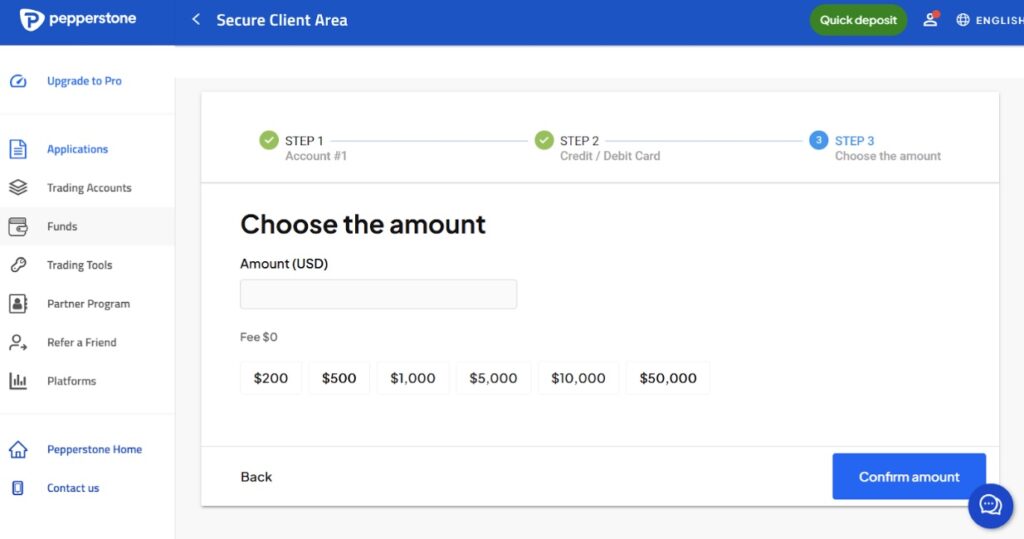
- Choose your funding method
Depositing on mobile
Depositing on mobile is very similar to the process on desktop.
Just tap the ‘Portfolio’ icon at the bottom of the screen, select your account, and tap the ‘Deposit’ button. The app will then guide you through the specific steps for your chosen payment provider.
How long do deposits take on Pepperstone?
Most digital deposit methods on Pepperstone are instant or near-instant. This includes:
- Credit/Debit Cards (Visa & Mastercard)
- E-wallets (PayPal, Skrill, Neteller, M-PESA)
- Apple Pay and Google Pay
If you choose to deposit via Bank Transfer, the process typically takes 1–3 business days for local transfers and up to 5 business days for international wires. Pepperstone does not charge any internal deposit fees, though your bank may apply its own processing or conversion costs.
How long do withdrawals take on Pepperstone?
Withdrawals at Pepperstone are generally processed within 24 hours. If you submit your withdrawal request before the daily cut-off time (usually 07:00 AEST), the broker’s finance department will typically process it the same day.
Once processed by Pepperstone, the time it takes to reach you depends on the method:
- E-wallets: Often reach your account within 1 business day.
- Cards and local bank transfers: Typically take 1–3 business days.
International bank wires: Can take 3–5 business days to arrive.
Fees
What fees does Pepperstone charge?
When trading with Pepperstone, keep three main costs on your radar: spreads, commissions, and overnight swaps. Think of the spread as the “gap” between the buy and sell price, that’s the broker’s cut for the trade. Commissions are flat fees for entering and exiting a position, mainly applying to the Razor account.
Then you’ve got “swaps.” Since leverage is essentially using borrowed cash to control a bigger position, Pepperstone charges you interest to keep that trade running into the next day. It’s a standard part of trading, but you must factor it into your profit targets.
A big plus for Pepperstone traders is that there are no inactivity or account maintenance fees if you take a break.
Commissions
Commissions are a fixed fee that you pay to trade. You will usually pay a commission to open your trade and to close your trade.
Pepperstone charges no commissions for its Standard Account but does charge them in its Razor Account.
If you decide to go with the Razor account, the commission you pay actually depends on which platform you’re using. It’s a bit of a unique setup:
- TradingView / MT4 / MT5: You pay $7.00 round-turn per standard lot ($3.50 to open and $3.50 to close).
- cTrader: You pay a slightly lower $6.00 round-turn per standard lot.
Overnight fees
As we mentioned, overnight fees only kick in if you hold a position past the daily rollover point (usually 5 PM New York time). They’re important to keep an eye on because if you’re holding a trade for the long haul, they can start to nibble away at your profits.
We find it’s easiest to check these live. Pepperstone makes it simple to see exactly what you’re being charged right on your trading ticket or in the “Market Watch” section of your platform. If you need to avoid these for religious reasons, they also offer a Swap-free (Islamic) account that uses a fixed admin fee instead.
Spreads
Spreads are typically the most important fee you’ll pay when trading CFDs.
Pepperstone has extremely competitive spreads for its CFD products, particularly when compared to other brokers regulated in tier-1 regions.
There are FX/CFD brokers with better spreads than Pepperstone but they tend to be regulated offshore.
Forex spreads
On the Razor account, Pepperstone offers “raw” spreads starting from zero in exchange for a commission on each trade. These typically average between 0.1 and 0.5 pips for major pairs. For a simpler experience, the Standard account includes all costs in the spread, which starts at 1.0 pip. Note that minor and exotic currency pairs naturally carry higher spreads due to lower liquidity.
Below, we’ve highlighted some of the specific spreads you can expect when trading with Pepperstone.
Commodities spreads
Index spreads at Pepperstone are very competitive and don’t involve a commission on either account type. Like most brokers, these spreads will vary depending on when you’re trading and how much liquidity is in the market.
- S&P 500 (US500): Typical spreads start from 0.4 points.
- DAX 40 (GER40): Typical spreads start from 1.0 point.
- UK100: Typical spreads start from 1.0 point.
Index spreads
For commodities, Pepperstone generally offers a similar spread structure across both accounts, and these are also usually commission-free.
- Gold (XAU/USD): Minimum spreads start at 0.10 points on Razor and 0.50 points on Standard.
- Silver (XAG/USD): Spreads typically start around 0.50 points.
- Oil (WTI/Brent): Spreads are ultra-tight, often starting from just 2 cents.
Platforms
Pepperstone offers several different platforms to traders. These are all what we would describe as trader-focused platforms, meaning they are not simple ‘buy and sell’ button platforms. If you’re into more complex trading this is obviously fine, but if you are looking for a simpler platform, another broker may be more suitable for you.
MetaTrader 4 and 5
Pepperstone offers both MT4 and MT5, the industry standards for many traders. MT4 is a favorite for automated trading via Expert Advisors (EAs), while MT5 provides a broader range of markets, more advanced order types, and updated features.
cTrader
Designed for an institutional-style experience, cTrader is ideal for experienced traders requiring more sophisticated trading tools. It is a good choice for those who want to build or run trading robots to execute strategies automatically.
TradingView
Pepperstone is fully integrated with TradingView, allowing you to trade directly from its world-class charting interface. This gives you the benefit of Pepperstone’s execution speeds combined with some of the best analysis tools available globally.
Pepperstone Trading Platform
This is Pepperstone’s own trading platform. Our experience of this platform was not that positive as it is not particularly user friendly or intuitive to use.
Copy trading
For a more hands-off approach, the broker supports several copy trading solutions. These allow you to browse the performance of experienced traders and automatically mirror their trades in your own account.
Final Thoughts
We like Pepperstone mainly because of its competitive pricing and the fact you have a lot of strong trust markers, which mean we would feel comfortable trading our money with the broker.
The company is definitely more geared towards knowledgeable, speculative traders. The broker’s pricing, products, and technology reflect that. So if you do bracket yourself in that category, the broker will be a great choice for you.
On the other hand, Pepperstone is not going to be for you if you’re looking to make long-term investments as it simply doesn’t offer the products for that.
If you’re also looking for simple, point and click trading or an easy to use mobile app, there are brokers out there which are better-suited for that.
FAQ






Latest News
LMAX will let clients put down crypto margin, which can be used to trade spot FX, CFDs, crypto, and perpetuals.
