
Reach 8m+ traders with cTrader today
Last week I saw that the liquidity provision arm of Leverate got a license in Mauritius. Looking back over the prior 30 day period on the day we published that article, 12(!) firms, including Leverate, got a securities dealer license in the country.
This is now normal but back when I first started in this industry, that was not really a ‘thing’ – it was generally about CySEC, the FCA, and ASIC. Getting a Seychelles and Mauritius license was not that common.
We noted last week that ‘going offshore’ has been a consequence of the leverage restrictions that so-called ‘tier-1’ regulators put in place back in 2018.
We saw more evidence of that from the FCA last Thursday too, as the regulator published a report which strongly suggested BD Swiss made over £75m from 2017 to 2021 from onboarding UK customers offshore.

Only the real deal – get access to genuine Prime of Prime services with ATFX Connect
But it’s one thing to say that from what you see happening and another to look at some hard numbers
So let’s start with Mauritius. Most brokers will get a full service securities dealer license in that sunny isle, excluding underwriting permissions. In simple terms this is a license that lets you do market making, not just STP.
The restrictions on leverage went live in the UK and European Union on August 1st 2018.
A grand total of 27 firms had received a full service securities dealer license from the Financial Services Commission (FSC) in Mauritius prior to that date.

Get Prime crypto access now with Scope Prime
The first of these was approved in 2004. So over a 14 year period, 27 firms had been approved.
Two of those firms had let their license lapse and the regulator had ordered another one to stop doing business. That means there were 24 active firms at the time leverage caps went into play.
How many firms have received approval since European regulators put those restrictions in place?
432
Lol

Get a Match-Trader server today
You can see the total of how many new licenses were issued each year below.
Note this is not a cumulative total – so we have seen an increase in the number of new licenses issued every year since 2018.
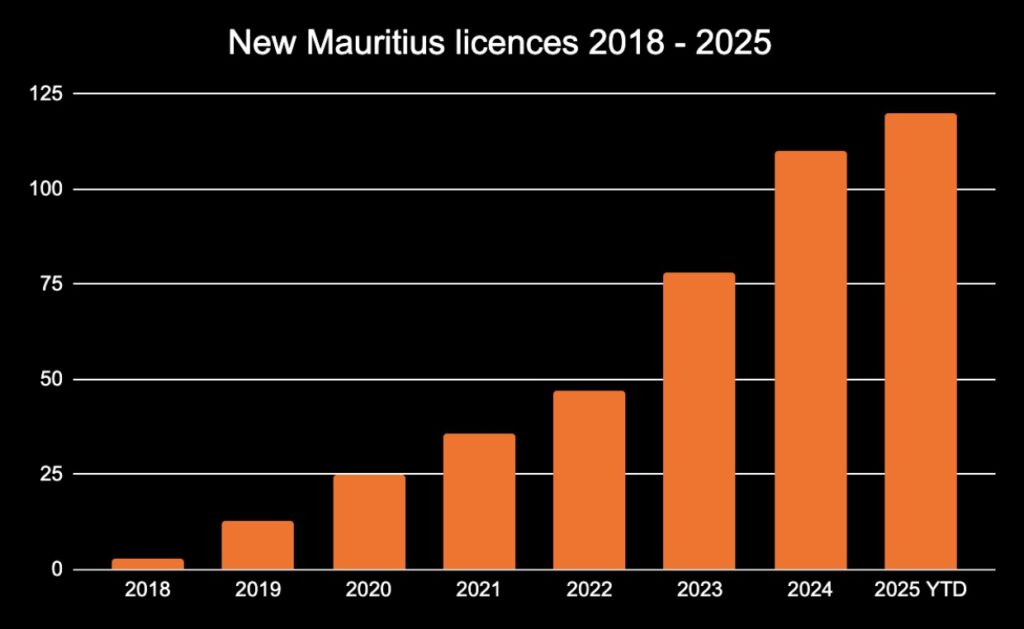
In the seven years since 2018, you have seen 16x as many firms get FSC approval than in the 14 years prior to that.
Now let’s look at the Seychelles.
The data I have indicates that at the end of July 2018, there were just 10 firms with a Seychelles broker license.

Start using Centroid to manage your broker’s risk
Today there are 216 – so a nearly 22x increase.
This is obviously a huge change and you have to wonder whether the two countries will come under pressure from other regulators at some point.
For example, the Seychelles regulator announced some changes earlier this year that suggest they want to increase the barrier to entry for firms.
Highfalutin brokers (IG, CMC Markets) have not gone to these places, probably for branding reasons or because they’re afraid they’ll blow up. It could be a combination of both.

On the other hand, how much there is that regulators in the EU can do to the Seychelles, for example, is not clear to me.
On the TradeInformer trip to Vanuatu we met the local regulator there and asked whether this was happening to them. The answer was no and that, if anything, relations with ‘tier-1’ regulators were positive, as they worked with them on a number of different projects and activities.
One thing you might expect from the growth in offshore licensing is a decline in the number of people holding CySEC licenses.
On the face of it, that has not happened. In July of 2018, CySEC listed 249 firms as regulated investment firms. Today it’s 248.
However, that figure is very misleading because of the huge number of firms that now send almost no retail flow into those entities.
For example, we looked at how many people work in CFDs in Cyprus in the middle of last year. Out of the 10 largest employers, I believe only one makes any meaningful money from Europe (eToro). Several of the others, notably Exness, do not even accept retail customers from Europe today.
If you think of this from a tax revenue perspective, the impact could be fairly meaningful. For example, I would guess that from one broker alone, the shift to offshore means that Cypriot authorities have lost out on cumulative tax revenues in excess of €120m since 2018. However, it’s plausible that shift would have happened anyway, assuming the brokers wanted to optimise for tax.
The UK is a bit of a different story. Most smaller and mid-size players were passporting into the UK via CySEC, so firms have not really pulled out in the same way. The obvious difference here is that the UK has a huge domestic market and Cyprus doesn’t, meaning there is some incentive to have a license here.
This is all good news for places like Mauritius, the Seychelles, and Vanuatu. They have been able to capitalise on Europe’s leverage caps. In Vanuatu this has had quite a meaningful impact as you now have a lot of local employees and money flowing into the country. I haven’t visited Mauritius or the Seychelles but I would imagine it’s the same.
For European regulators it means less tax, less local employees, and less oversight of who’s doing business. Do they care? I think for a lot of them it’s “out of sight, out of mind”.