


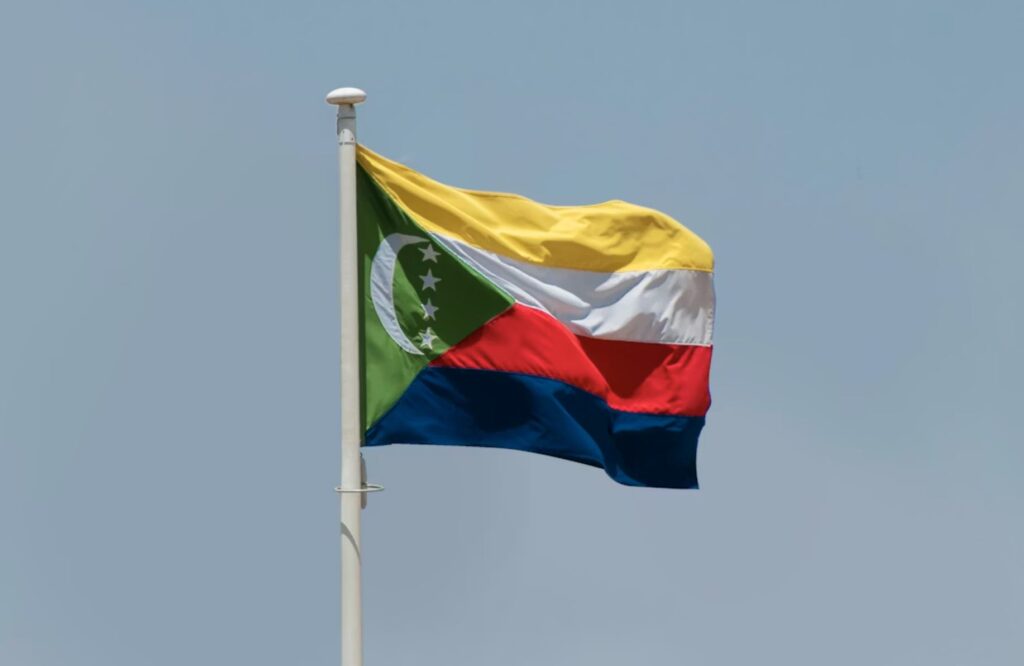

A mad German man once said that if you look too long into the abyss, then the abyss looks into you. If he was working in the CFD industry, he might have said that if you look too deeply into the Comoros, the Comoros will start looking into you. Let’s hope it doesn’t happen to me.
The Comoros has long been a place that brokers go to get an offshore license. For as long as that has been happening, there have also been people saying it’s fake. Last week we reported that one major technology vendor is allegedly no longer taking these licenses.
What has actually happened?

To understand this, it seems that you have to learn a little about Comoronian history. The Comoros is made up of three islands – Grande Comore, Anjouan, and Mwali. It became independent from France in 1975 and has had more than 20 coups or attempted coups since then.
In 1997, Anjouan and Mwali split off from the Comoros and declared independence unilaterally.
Quite what happened after this is hard to say. A US State Department report from 2007 indicates that in 1999 Anjouan started allowing ‘International Business Companies’ to be registered locally. Mwali did the same in 2001, although it rejoined the Comoros the following year.

These rules appear to have provided the initial basis for offshore activity. One thing that is clearer is that, at some point in the early 2000s, the ruler of ‘independent’ Anjouan – Mohamed Bacar – conferred the right to issue offshore licenses to a Hong Kong businessman called Johnny Sei-Hoe Hon.
A 2006 report in Africa Intelligence indicates Hon then sold the right to issue and manage licenses to Anjouan Corporate Services, which continues to manage that activity until today.
As for Mwali, the same structure set up appears to have taken place but it is not obvious who is managing the license or if they even have – or ever had – any connection to the islands.
The problem for both parties is that there have been repeated claims that their activity is illegitimate. This has been going on for over two decades as well. Bizarrely, the 2007 US state department reported that…
“In November 2004 and again in December 2005, Anjouan island government officials denied island government involvement in the offshore sector.”
This was despite the fact that Bacar was part of a legal case in the 2000s, helping establish Hon as the legitimate agent to sell offshore licenses. Go figure.
What makes all of this even more complicated is that Bacar was deposed in 2008, after Anjouan was invaded by the Comoros and soldiers from the African Union. The island was reincorporated into the Comoros in the same year. Bacar was given asylum in France, after he fled Anjouan on a speedboat dressed as a woman. No I’m not making this up.
In practice, this means that Anjouan was something like an unrecognised independent state from 1997 to 2008, meaning any rules or regulations it made during that time are legally questionable.
In 2013, the Comoros Central Bank, the country’s financial regulator, issued new rules that defined the bank as the sole financial authority in Comoros. This includes overseeing financial intermediaries, which you would assume includes CFD providers.
This built on prior rules, which the US State Department cites in its 2007 report. That report notes that:
According to article 7 of this legislation, a bank or any other financial institution cannot operate in the Union of the Comoros without prior authorization from the Union Finance Minister upon recommendation from the Comoros Central Bank. Thus, offshore banks operating in the autonomous islands of the Union of the Comoros without prior authorization from the Finance Minister contravene the May 3, 1980 legislation
In December of last year, the Comoros Central Bank and the country’s Ministry of Finance both published a press release. The Ministry of Finance’s press release states that:

We are following up on the statement from the Central Bank of the Comoros warning the public against several banks that claim to be licensed by competent Comorian authorities to carry out offshore banking activities.
However, alongside offshore banking activities, another fraudulent activity involving the issuance of licenses in the Forex and cryptocurrency sectors has been observed.
The Ministry is working to establish a regulatory framework for the issuance of official licenses…In the meantime, any promotion or use of unofficial licenses is strictly prohibited.

If it is indeed the case that the technology vendor has stopped serving brokers with licenses from the Comoros, it may be due to this.
It also looks like a battle is brewing between ‘federal’ authorities and any local authorities (assuming they even exist) that are supporting these local licenses. But this debate has been going on for more than two decades. Let’s see what happens.