
- How do you start a prop firm?
- What are the differences between running a prop and a broker?
- What are props doing today that makes them money?
- All this and more in this month’s cTrader webinar
Back in 1990, the American journalist Bill Buford published a book called ‘Among the Thugs’.
This documents a period of close to a decade that Buford spent with football hooligans in England.
To a large extent the book is a study in crowd behaviour and violence. There is an amazing bit when he goes to the Italian World Cup in 1990 and describes the build up to a riot.
Everyone is milling about, there is tension in the air, and then one person comes out from the crowd – he may now be an employee at London Capital Group, I’m not sure – and throws a bottle at the Italian police. As soon as this happens, everyone goes crazy and the riot begins.
The point is that until that one person steps out from the crowd, nothing happens. After they do, everyone else feels free to join in.
Until now some companies from the broker space have joined in with prop firms. But those have all been privately held companies that primarily do IB business in emerging markets. That’s not knocking them, it’s just that they’re not super public-facing businesses.
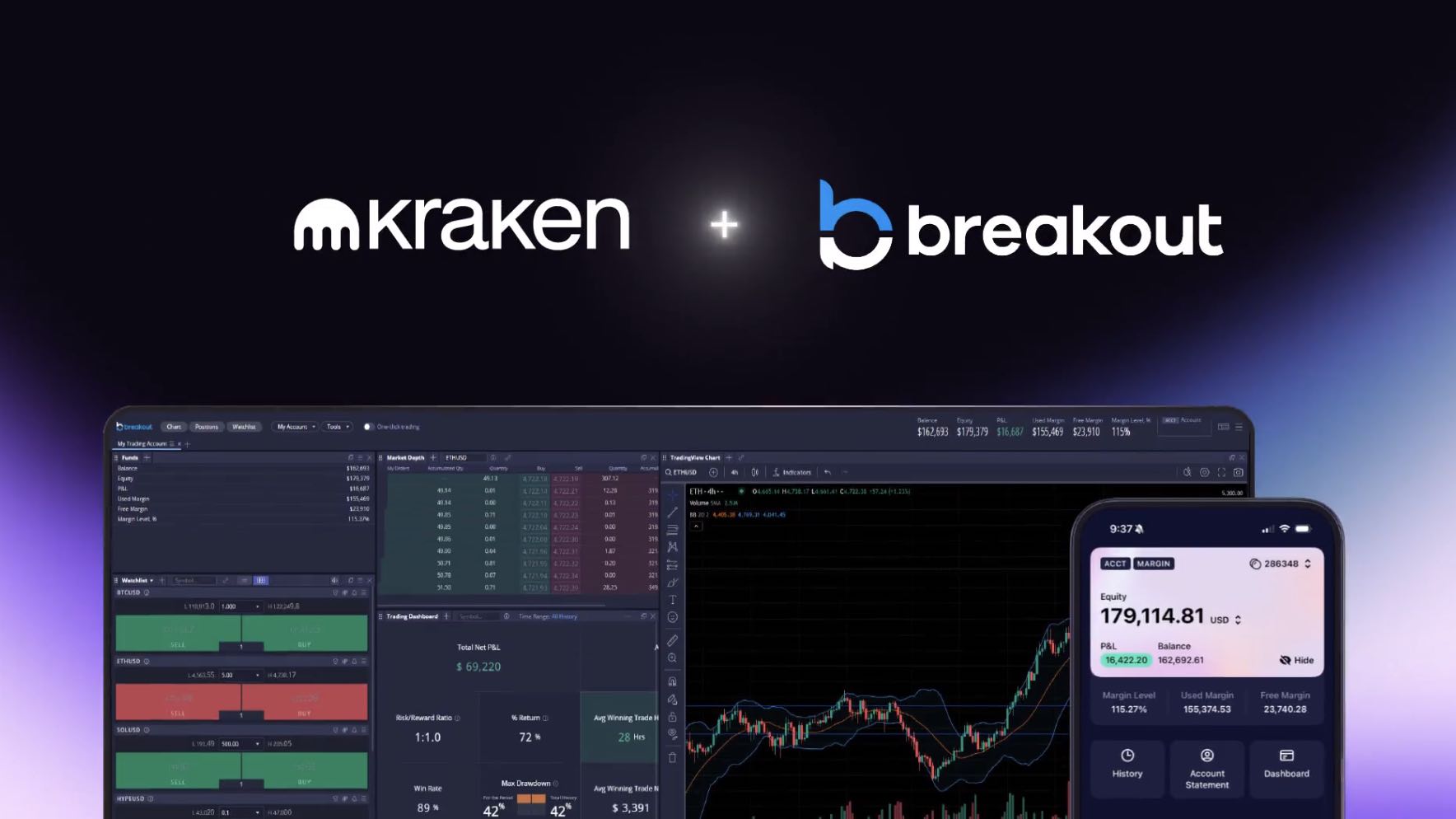
Last week crypto exchange and trading platform Kraken bought Breakout, a prop firm that offers crypto funded accounts.
I think this could be the equivalent of the guy walking out into the crowd and throwing a bottle at the police.
Kraken is big, it’s American, it’s regulated, it offers the full set of products that most of the big industry players want to, and they want to go public next year. Of all the firms that have added prop, they are for sure the most ‘legit’.
Consequently, if you are a big player, you must be looking at this and wondering if you can do the same. It will still take time. By way of comparison, just think how long it has taken some companies to add physical crypto trading. But they still did it in the end.
There are a few points to note. One is that Kraken’s own press release about the acquisition says that Breakout traders can get up to $200k notional. The actual value seems to be $500k. Maybe that’s me nitpicking or maybe they actually don’t get the product.
Anyway, the first main point is that Kraken must be among the best capitalised prop firms in the industry now. Reports in July suggest the firm is looking to raise $500m ahead of a $15bn IPO.
When you combine this with brand and reputation, it seems like they could quite easily become a ‘go to’ place for prop trading. Imagine how so many brokers struggle to compete with players like eToro or IG Group. Maybe the same could happen with Kraken and prop.
The other interesting benefit is for Kraken. If you look at a lot of crypto firms, they have historically been extremely blase about doing unregulated business. Partly that’s because of a lack of crypto rules but, in general, they just don’t seem to care that much about taking customers without local approvals.
Consequently, it’s plausible they could use prop to enter new markets or simply to be more aggressive in marketing in existing, regulated markets. For example, crypto derivatives are banned for retail in the UK. Crypto props are not. This is basically the main benefit of prop today so it would be weird if they didn’t do stuff like this.
The final point is whether prop just becomes one of many products that you can offer. This is basically what Kraken already does. If you look at the their website, it’s a lot like eToro, IG, or Trading 212 – it’s set up to offer everything but ultimately to push you into derivatives.
In that sense, prop could become what CFDs are for a lot of players now. Not a product you do a lot with publicly but one of several that you ultimately nudge customers towards so that you can make more money from them.