


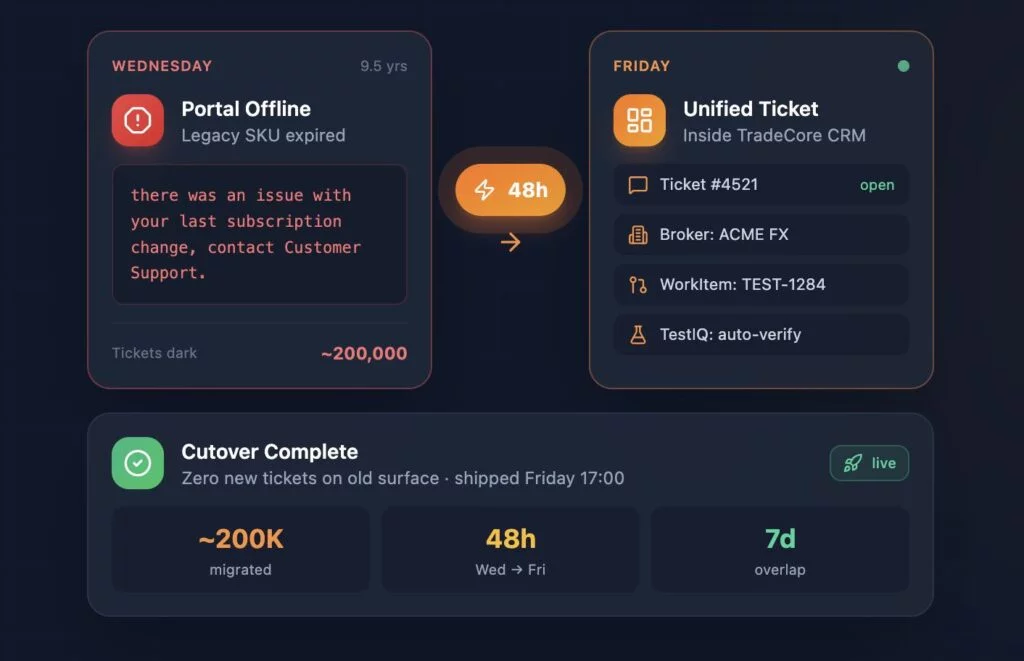
TradeCore, the CRM and workflow platform used by a range of FX and CFD brokers, has dropped Zendesk and replaced it with a support system it built in-house in around 48 hours.
The trigger was about as mundane as these things get. According to the company, TradeCore went to add a handful of support agent seats. The self-service page in Zendesk errored out, and Zendesk’s support team offered to process the order manually as a new contract term. TradeCore paid. A few hours later, its broker clients lost access to the support portal that holds close to a decade of their support history.
In a blog post published this week, TradeCore CEO Igor Jovic says the new contract silently could not carry forward the legacy product that ran the customer-facing help centre, which took the portal down with it. The new terms, he says, were roughly four times more expensive per seat and came with a forced annual commitment. To restore what it had lost, the company says it would have needed to move up to a higher-tier plan.
“Every dollar we sent them after that would have felt like paying a ransom fee to a company holding our clients hostage,” Jovic wrote.
Instead of paying, TradeCore’s team rebuilt the support layer on its own platform over the following two days. Jovic describes it as an “ultrahackathon”: the team worked through the nights and shipped a cutover by the end of the week, while, keeping the rest of the company’s operations running with zero downtime.
The speed claim will raise eyebrows, and Jovic is candid about why it was possible. TradeCore already runs a CRM and workflow stack for brokers, so much of the plumbing a ticketing system needs was already in production. Nearly ten years of running broker support, he argues, meant
the team did not have to work out what to build. AI tooling gets a brief mention as one of the tools the team used, not as the headline.
Zendesk’s account team, in correspondence quoted by TradeCore, acknowledged the disruption. The company says it was told, in writing, that Zendesk “should have had a clearer conversation about the legacy SKU” and that it understood the broker clients “haven’t been able to raise requests, which I know has been highly disruptive.” Zendesk had not made a public statement on the episode at the time of writing.
The story sits on top of two debates the industry knows well. The first is the old build-versus buy question, given a fresh edge by how quickly small teams can now assemble software. The second, more interesting for brokers, is consolidation: TradeCore’s argument is that support
belongs inside the same platform that already runs the customer relationship, rather than in a separate tool with its own pricing leverage. The company says putting support on its own platform also let it connect tickets to the rest of its stack, turning a client’s bug report into an automated test that runs against that client’s own configuration. Jovic used the post to make two public commitments to TradeCore’s own customers: that it will never silently move a customer to a different pricing tier, and that every customer will always have a clear overview of what they pay and why. The full account is on the TradeCore blog.