



When IG released its results a couple of weeks ago, one of the points the company’s CEO Breon Corcoran made in the call was about a growing convergence between gaming, trading, and investing. On TradeInformer, we have called this process Robinhood-ification in the past and it’s where you sell low-risk, mass market products, which you use to cross-sell into higher value, financial gaming products.

Corcoran noted that the US is effectively the epicenter of this trend and that it has the most friendly regulatory framework for it. I think this is correct, although I’d add the caveat that it seems heavily tied to the Trump administration. What happens if the Democrats return is less clear.
Regardless, for most CFD brokers, all of this may seem counterintuitive because the US is a big ‘no no’. That is because the exchanges successfully lobbied to heavily restrict OTC trading. At the same time, the Americans will send in SEAL Team 6 to perform a Maduro-style extradition if you take their customers offshore. Obviously this doesn’t stop US companies from doing exactly the same to people in your country. Life is not fair, I guess.

But even if regular CFD providers aren’t taking customers in the US, we are seeing a decent number of the big players now targeting the country. Today, XM, CMC Markets, IG, Plus500, and eToro all have a regulated presence in the US.
Tickmill co-founder Ingmar Mattus has set up a futures broker – MetroTrade – in the US too. IQ Option owner Quadcode is also involved in the Land of the Free, with ownership stakes in Polymarket and Florida-based prop trading group Game 7. Prop firm FTMO also has a major US presence, following its acquisition of brokerage group OANDA. The US also seems to be the biggest market for FOREX.com.
For IG and Plus500, the US is the main growth market. Indeed, it is hard to see any other market globally – apart from maybe India for Plus500 – that can deliver meaningful revenue growth for these firms. The same is true for eToro but they are too late to the game and do not appear to have a strong USP that can help them grow there.
There are four different products that I think are appealing to people targeting the US:
- Prediction markets
- Options
- Futures – especially perpetual futures
- Prop trading
Prediction markets
IG and eToro will both add prediction markets this year. Plus500 has already added them to its US offering. IQ Option has a direct stake in them via its holdings in Polymarket.
Financially these are good products. For example, Plus500 charges $0.01 per side, in addition to any exchange fees. Without factoring in exchange fees, this would mean the highest value contract you could trade on at Plus500 would be $0.98. This means commissions are a minimum of 2% for a trader exiting a position before expiry. For example, if you bought a contract at $0.40 and then sold it at $0.50, you lost 20% of your profit to commissions – a figure that would be considered insane in the equities space.
There are also signs that you’ll be able to offer prediction markets with leverage, something that gives even me a feeling of ‘isn’t that a bit rich?’
The main problems and risks with event contracts appear to be:
- Huge potential competition from iGaming companies, who are looking to enter the space or already have
- Default brands have arguably already been established (Kalshi, Polymarket, Robinhood), making revenue growth extremely difficult
- Potential for bans on sports-related contracts, which constitute ~90% of volumes
- Limited ability to offer parlays on sports or other contracts
Options
Options trading is probably the least attractive product of the four mentioned. It is logistically hard to offer and you are competing with very established brands. Good luck trying to beat Robinhood, for example.
eToro has tried to push options in the US, having acquired local broker Gatsby in 2022. Nothing seems to have come of that yet. A simple sign of that is the fact the firm doesn’t break down any option-based revenues in its financial reports.
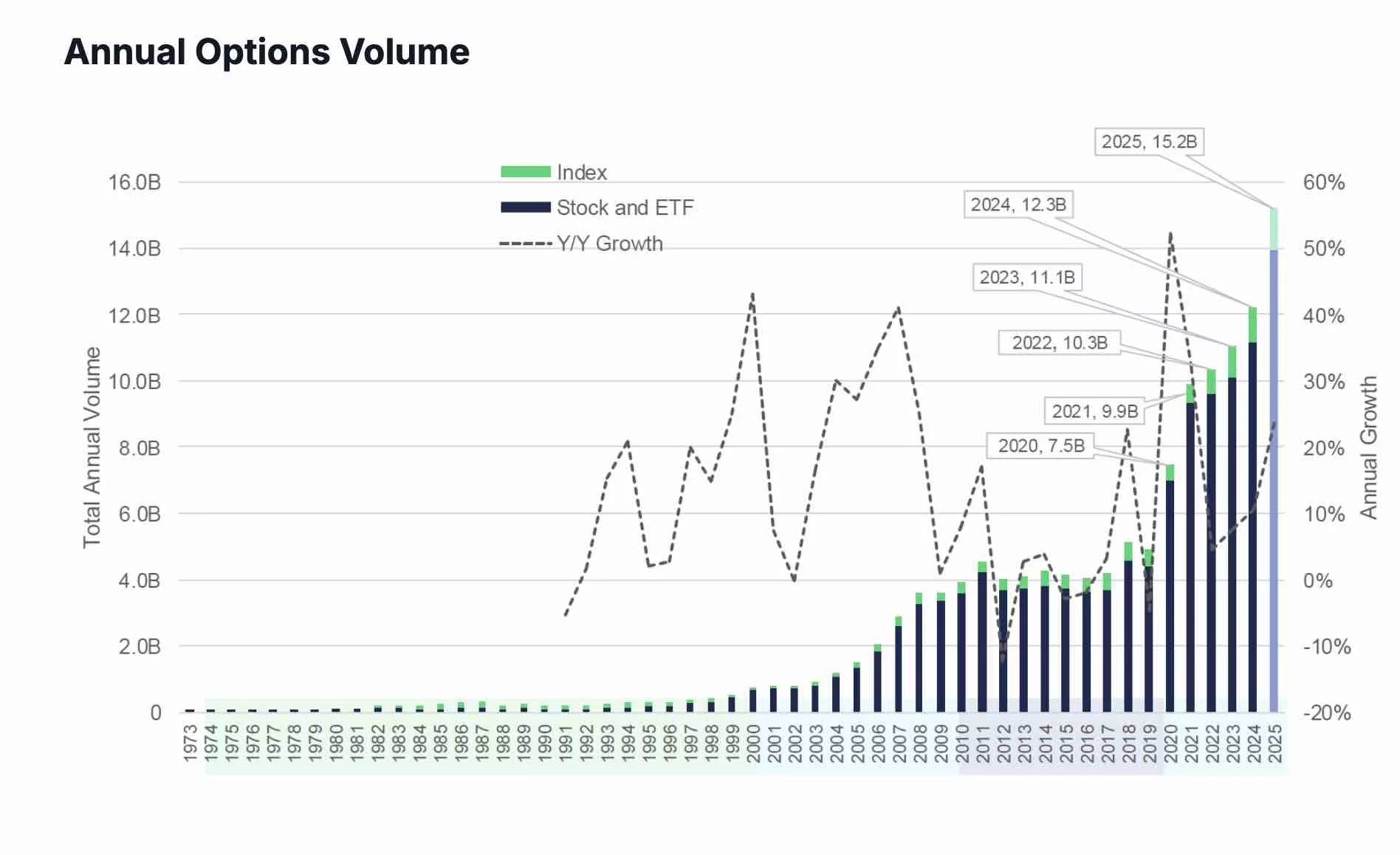
Options trading is still attractive to retail. For example, approximately 60% of SPX options trades last year were traded 0DTE. This is not an entirely retail phenomenon, but they are big drivers of it. You can see growth in volumes above.
However, the basic problem is complexity and competition. Options are difficult to launch and expensive to market. It’s like launching CFDs in the UK and trying to compete with IG. If anyone else from the CFD world does try to enter the US, I don’t see this as a product they will push.

Futures
Futures are more exciting. They have more similarities with CFDs and we see trends that are pushing exchanges to offer products that are structurally extremely similar to CFDs too. Revenue seems to be based on a mix of commissions and autoliquidating positions that fall into a margin call or which are not fully margined by the end of the day. We’ve noted before that intraday margins mean brokers – like Plus500 – can offer leverage equivalent to ~700:1 or higher.
This model is becoming more attractive for two main reasons.
- Smaller and smaller contract sizes means positions can be opened for $40 – $50, broadening market access
- The approval of perpetual and spot-quoted futures. These allow firms to offer spot-priced contracts which effectively have no expiry. These are more intuitive for retail customers to understand.
As a result, we are getting to a point where in the US, you can imagine a scenario in which it’s possible to trade a spot priced gold contract with >500:1 leverage. Of course, the contracts will never be as customisable as a CFD or spread bet, but they are the next best thing.
I believe the primary split here will be between crypto firms and ‘regular’ brokers. Crypto traders don’t like feeling as though they are trading ‘trad-fi’ products. So even if a crypto perpetual had exactly the same structure and offering (eg. XAU/USDT) as an equivalent ‘normal’ contract (XAU/USD), they will trade the crypto one. Whether those two can converge or if they’ll remain distinct is something I think we’ll find out in the next couple of years.
Prop trading
Despite the wrath that prop trading still seems to incur from some CFD executives, it is the most attractive option for CFD brokers looking to tap into the US market. Established players are already doing it.
For the local players, Plus500 has an exclusivity arrangement, for brokerage services and technology, with Topstep, which is probably the largest futures prop firm in the US. Tickmill is helping facilitate prop firm futures trades. Aside from founding MetroTrade, Mattus also owns part of TradersYard, a prop firm that appears to have shifted to heavily market in the US since the start of this year. As noted, IQ Option’s owner now has a large stake in a US-based prop firm, as well as the main tech provider in the prop space.
OANDA, one of the biggest forex brokers in the US, is now owned by prop firm FTMO. Kraken, arguably the second-largest US crypto exchange, offers prop trading directly to US customers, via its Breakout brand. Futures broker NinjaTrader, which Kraken also owns, now has a white label solution for prop firms and a dedicated section on its website for the product.
Leaving aside the fact you have many US-based prop firms, like Tradify and Topstep, you also have a lot of players taking US customers from elsewhere. For example, Aussie broker Blueberry has a futures prop firm that appears to take on a decent number of US customers. You can see some other examples of this below, with data taken from SimilarWeb.
| Prop firm | Total web traffic | Percentage from the US |
|---|---|---|
| Alpha Capital Futures | 1.6m | 11.7% |
| FundedNext | 6.9m | 9.0% |
| E8 Markets | 567,000 | 16.3% |
| Blueberry Futures | 48,000 | 8.5% |
| FXIFY | 42,000 | 31.3% |
By and large, any prop firm offering futures is doing it in large part to target US customers. Prop trading will continue to be the most popular product to add for US customers because it’s the cheapest and easiest to offer, given the lack of regulations. Despite the hate the sector continues to get from many of you, it is now abnormal for a CFD broker to not be involved in the space, rather than the other way around.
Looking at the rest of the US, I would say companies that actually go and get regulated there are likely to see the products mentioned in this order:
- Futures – including perps and spot-quoted
- Prediction markets
- Options