


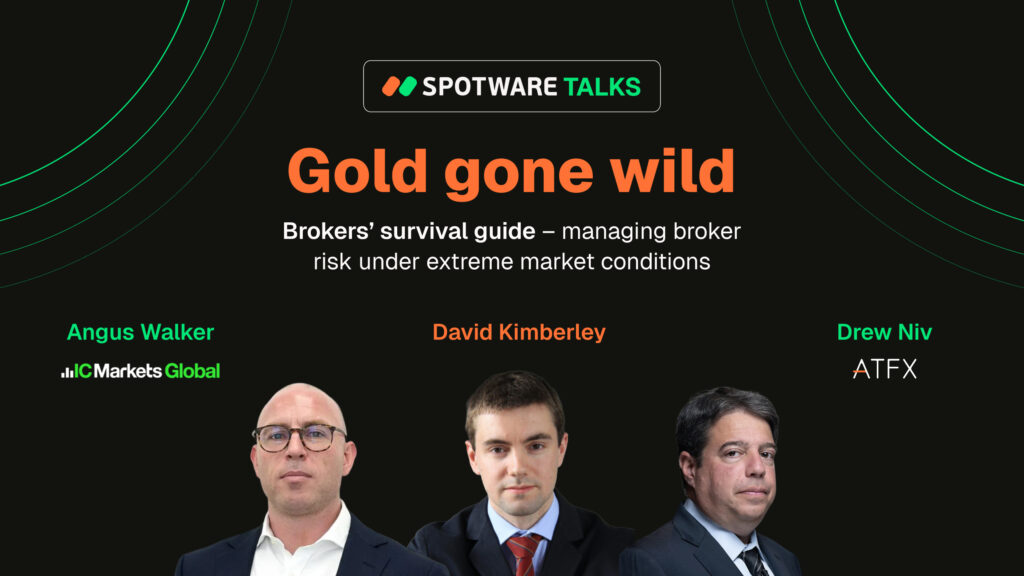
The first edition of Spotware Talks went live last week. Drew Niv, Chief Strategy Officer at ATFX, and Angus Walker, Global Head of Trading at IC Markets, both joined to discuss what happened with gold and what brokers can do to stabilize their business in the future.
You can watch the whole conversation on YouTube but we figured it would be good to pick out three of the juicier points made over the course of our discussion.
- Rolling, big whales, and universal leverage
One of the points that Drew and Angus noted was the difference between firms that continue to have high levels of intraday trading, which can help them generate transactional revenues, versus those that saw a lot more rolling of positions.
“If you’ve got a lot of volume turning over, that essentially offsets any market risk losses,” Angus noted. “So the higher the volume, generally, the better it is. But if you start rolling those positions because people are holding, then that presents a different challenge altogether.”
Drew built on that point, arguing that firms which had too much exposure to a small pool of large clients, particularly if they did not adjust leverage terms for them, were more likely to get hit by the trading activity we saw in the gold rally at the end of last year and into January.
“We think, ‘oh, if we like $10,000, we like a million dollars more,’” said Drew. “Of course we do. But the million dollars, you cannot give them the same conditions that you’re giving to the $10,000 client. That’s where risk management becomes a real problem. And in one-sided markets, it is a huge problem to hedge that if you need to hedge it.”
- “It would be easy to get run over”
Another interesting point that the two discussed was around broader risk management frameworks – how do you actually get yourself set up to deal with problems, like we saw in January, before they arise.
Angus highlighted the fact IC Markets has a more mature framework for managing risk, with a set of policies in place on what steps to take. This helped the brokerage group avoid some of the losses that allegedly took place elsewhere in the market.
“We dropped leverage on silver early on, as did a few other brokers in the market,” he said. “Platinum and palladium went all of a sudden, and we had some concentration risk there for a short while. And without the right team and framework in place I think it would be very easy to get run over.”
Drew also added that firms should be looking at underlying markets to get a sense of how their own risk set up should be. Many brokers compare their pricing to other brokers, without ever looking what is going on in the real gold market, he said.
“Most people will say, ‘oh, I hedge with a prime of prime, so I wanna see my fake gold rates [in] comparison to his fake gold rates and see how the market is doing,’ said Drew. “But then you are no different than a prop firm, right? So you should also have the futures up, right? Because you can see depth of market, you have to follow margin requirements, you follow spreads. That is the underlying market, and people are not running analytics versus the real underlying markets.”
- AI will make life harder for brokers
One of the most striking points made during the conversation relates to AI. Although there is a lot of hype around the technology, Drew argued that it will make it much easier for smart traders to build more sophisticated trading systems.
This is not to say that people will become smarter or that AI will make things simple. Instead it means that an intelligent trader, who was already with you as a client but may have not have the ability or ‘tech support’ to build this type of system, now can.
“I’ve been saying this for a lot,” argued Drew. “AI is gonna make this 10 times worse because, you know, it’s not that it increases the amount of smart people in our client base, but it decreases the cost of tech help for those smart people.
“So those same people that can come and take us for a ride for $20, okay, can now take us for a ride for $500. They don’t need programmers because they have AI, right? It’s not gonna make nondisciplined traders disciplined. But you take that 1% of the client base, that is what we always segment, that has a high knowledge level, meaning he’s a super disciplined trader. You get those people free tech help from AI, the amount of problems they can make when you offer unrealistic prices is going to be brutal.”