




Reach 11m+ traders with cTrader
A common theme in this newsletter since I started is that a CFD broker is a great business to own and a terrible business to take public.
Usually there are two reasons for this. Firstly, CFD brokers cannot scale that much. This means that large fund managers are often prohibited – because of size constraints – from investing in them.
Alternatively they will end up being such a tiny proportion of a portfolio that returns won’t be meaningful. This is why, for example, most of CMC’s investors are small and mid-cap funds – no one else can buy.

Only the real deal – get access to genuine Prime of Prime services with ATFX Connect
The other problem is ‘gray area’ business. If you own a CFD broker, you are happy to take on the risk that reverse solicitation business brings. Outside investors are typically not happy to do this.
For example, iForex is supposed to be going public at some point in the UK. I have not heard anything about that for ages now and would not be surprised if it’s because their biggest market is Japan, where they don’t have a license.
Towards the end of last year, a legal case in Australia came out that illustrates a lot of these points.

Get true Prime crypto access with Scope Prime today
Back in 2018, Pepperstone underwent a management buyout. The seller was CHAMP Private Equity, an Aussie private equity group.
Before looking at the legal case, it’s worth noting why CHAMP ended up buying (and selling) the broker in the first place.
Pepperstone was looking to go public around 2014 and 2015. However, the company had a huge book of business in Japan that was all offshore. It was forced to stop doing business there in order to pursue the IPO.

The best brokers use Pelican for copy trading – why don’t you?
That IPO never materialised and the original owners of Pepperstone, Joe Davenport and Owen Kerr, then sold 60% of the business to CHAMP in 2016 for AUD 90m (approx. $67.5m at the time).
However, CHAMP then looked to offload the business in 2018 – why?
Firstly, they were worried about the regulatory changes in Australia and other parts of the world that capped leverage. They were also ‘concerned’ with the business the broker was undertaking in China.

Manage your broker’s risk with Centroid Solutions
The PE firm thought the company would have to drastically change in order for them to feel comfortable holding on to it.
However, Davenport objected to any China exit as it would “hinder any sale process”. I take that to mean it’s a significant part of the business and so would kill the valuation if they did.
So you can see that founders like Davenport are happy to take on the reverse solicitation risk. Private equity investors are not.

Start hedging with Hantec Prime today
After this happened, the management buyout took place, with the main parties in that transaction being Pepperstone’s CEO Tamas Szabo and Fiona Lock.
Lock had worked at CHAMP for almost two decades prior to this and appears to have been one of the main people behind the PE firm’s decision to invest in Pepperstone in 2016.
The basic deal that was agreed was that CHAMP would lend the new Pepperstone owners AUD 150m (approx. $110m) to buy the broker. They would pay that back by paying out the maximum level of quarterly dividends + interest until the full balance of the loan was repaid.
Another part of the deal was that once the repayment was complete, Pepperstone had to split any profits in excess of AUD 25m until the private equity fund that held the shares in the broker was wound up.
For reasons that are somewhat amusing and appear to have been mainly about Lock not wanting to do a profit split, CHAMP and Pepperstone went to court. The case is a long-winded one and can basically be summed up as Lock did not want to do the profit split and so found an error in the legal wording of the agreement to justify not paying it.
What is more interesting for our purposes is that in May 2022, Pepperstone repaid the full amount due to CHAMP, totalling AUD$ 211,686,064.50 (approx. $154.5m).
So in 3.5 years, Pepperstone generated over $150m in cash that it could pay out as dividends. Note that this was in a period where they were also dumping huge amounts into large-scale branding partnerships as well, so it’s not like they were killing the business to pay that amount of money out.
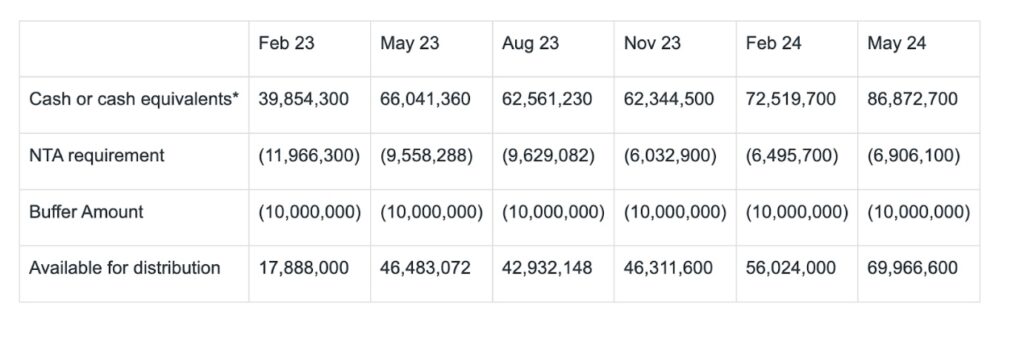
Pepperstone did not pay any of the subsequent profit share agreement and the amount due seems to still be determined by the court. CHAMP hired an accountant to determine how much they were owed, with the figures in the table above being the outcome. The bottom row is the theoretical level of dividends that Pepperstone could have paid on a quarterly basis.
So taking a step back, the buyers of Pepperstone got…
- A full, up front loan, with almost no downside risk if things didn’t work out
- They probably got awesome salaries for the duration of the loan
- They paid the loan off in less than four years
- Even if they had paid the profit share, they could have worked for one extra year and never had to work again from the dividend payments alone
- Err…they now own a massive business?!
Maybe I am not ambitious enough or something but I can tell you friends that I would be walking with a spring in my step if this was me. Am I missing something?
The only ‘problem’ they now face is finding a buyer. Lock is a private equity person and so will probably want to sell. Going public will be hard (no growth + problems with offshore China, Singapore etc), so they’ll have to find a private buyer. I guess there are worse problems to have?