


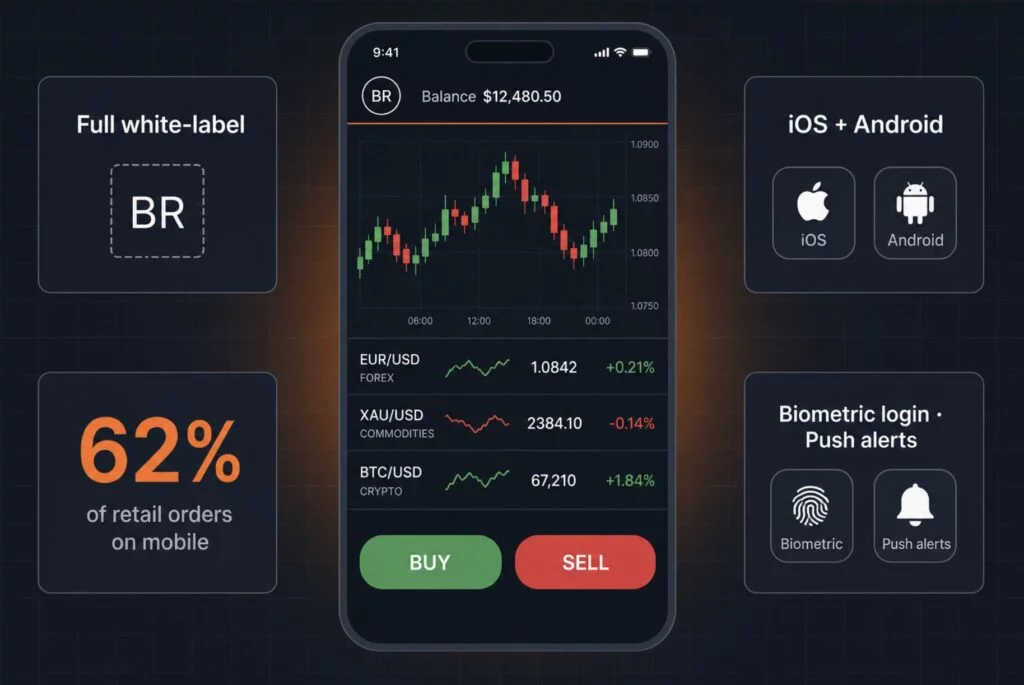
A retail trader in 2026 opens their broker’s app more often than they open almost any other piece of software in their day. The numbers behind that sentence are no longer marginal: more than half of all retail trades now execute on mobile, Charles Schwab has reported 62% of retail orders placed from a handheld device with app sessions up 34% year-on-year, and mobile trading usage is up roughly 120% since 2020. In emerging markets the trend is sharper still — for a large share of new traders, a smartphone isn’t the primary way they reach a broker, it’s the only way.
Which raises an awkward question most brokers haven’t sat with: the single most-used surface in your client relationship — whose brand is actually on it?
For a lot of brokers, the honest answer is “not entirely mine.” The mobile app category is full of compromises that leak the vendor’s brand into what’s supposed to be the broker’s storefront.
App Development Approach Comparison
| Feature | Platform-native white-label app | Webview “wrapper” | Build your own |
| Looks & feels like a real app | ✓ Yes | ✕ It’s a website | ✓ Yes |
| Published under your store account | ✓ Yes | ~ Sometimes | ✓ Yes |
| Accounts across all your platforms | ✓ 8 platforms | ~ Varies | ~ You build each |
| Separate integration project | ✓ None — same back office | ~ Varies | ✕ Full build |
| Time to launch | ✓ Activates on existing config | ~ Weeks | ✕ 12–24 months |
| Cost | Monthly add-on — no build cost | ~ Low | ✕ High to build + maintain |
Three compromises are worth naming, because they’re the ones traders actually notice.
Here is the text with an extra space forced between the bold headers and the paragraphs. Adding an empty line with a non-breaking space ( ) ensures WordPress won’t collapse the spacing when you paste it in.
- The webview in a costume
A surprising number of “broker apps” are the broker’s web portal loaded inside a thin native shell. It installs from the store, but it behaves like a website because it is one — and traders can tell. The tell isn’t a logo; it’s the feel. Scrolling, transitions, load behaviour. An app that feels like a browser tab quietly tells the client they’re using something built for everyone, not for them. - The store listing
Open the App Store entry and look at the publisher field. If it says the technology vendor’s developer name rather than the broker’s, the broker doesn’t really own the listing — they’re a tenant on it. The same goes for the support email in the listing and the privacy-policy contact. These are small fields that consumers rarely read and regulators always do. - The handoffs
This is the subtle one, and it’s where the category gets genuinely hard. Two flows in any trader app touch sensitive data: funding and identity verification. Both, in practice, complete on hosted pages — a payment service provider’s checkout, a KYC provider’s capture SDK. That’s not a flaw; it’s the correct, PCI-compliant way to handle card data and document capture on a phone. No serious broker wants to custody card numbers in their own app binary. The question isn’t whether those steps are hosted — they should be — it’s whether the rest of the journey around them is the broker’s brand, or whether the app dumps the trader onto an obviously third-party surface and hopes they don’t notice.
The interrogation worth running at iFX
So if “fully white-label” is the claim, here’s the short interrogation worth running on any vendor at iFX this month:
- Is it a real native app, or a wrapped web portal? Ask to install it, not just see screenshots.
- Who is the App Store / Google Play publisher of record? It should be the broker’s developer account, full stop.
- Does it run on the broker’s domain, with deep links carrying that domain?
- How many trading platforms does one app actually show? A broker running MT5 and a prop platform shouldn’t need two apps.
- What happens at the payment and KYC steps? Hosted is fine and expected — but the surrounding experience should still be the broker’s brand, and there shouldn’t be a second system to integrate or reconcile.
- And the unglamorous one: what does it cost, and is it a build or a switch? A native build is a 12-to-24-month project the broker then maintains forever. A platform-native app that activates against existing configuration is a different economic animal entirely.
None of this is exotic. It’s the difference between an app that deepens the broker’s brand on the client’s most-used screen and one that quietly advertises that the broker is one of many on a shared stack.
Disclosure: TradeCore has just launched the BrokerIQ Trader App, a white-label client app that runs on the same back office as the broker’s CRM and web portal, across the eight trading platforms the platform integrates. We built it because we kept watching good brokers lose brand control on the one surface that matters most. We’re demoing it on a live brokerage at Booth 83 at iFX EXPO Cyprus, 16– 18 June — and you’re welcome to run the interrogation above against it in person. But run it against everyone. The app is your storefront now. It should have your name on it.